Invisible data, visible mystery
Ball lightning—glowing, self-contained spheres that appear during thunderstorms—sits uneasily between folklore and laboratory physics. Witnesses describe marshmallow‑sized or car‑sized orbs that float, bounce off objects, pass through windows, and vanish with a pop or slow fade. The phenomenon is rarely lethal but reliably uncanny. For a phenomenon reported across cultures and centuries, it has stubbornly resisted a single convincing, widely accepted physical explanation.
What we actually know
Reliable observational facts are thin but consistent: the events are brief (seconds), luminous across visible wavelengths, often associated with ordinary lightning or strong electric storms, and can deposit heat or cause small damage. A few instrumented and photographic records exist, but they are the exception. Most of the corpus is composed of credible eyewitness accounts—useful but incomplete for constructing a mechanism.
Leading hypotheses (and their problems)
Over the years researchers have proposed a spectrum of mechanisms. That plurality is itself telling: the data do not strongly favor one model.
- Combustion of aerosols: One influential idea (Abrahamson & Dinniss) posits that lightning vaporizes silica in soil, producing silicon nanoparticles that oxidize and glow as an aerosol cloud. This model plausibly explains low-temperature, long‑lived glows but struggles with high-energy reports and with instances far from ground contact.
- Microwave cavity/plasma: Some propose lightning excites microwave radiation trapped in a plasma cavity, sustaining a glowing ball. This can account for apparent solid behavior and long lifetimes, but requires specific cavity conditions and an energy reservoir that is hard to demonstrate in nature.
- Plasmoids and self‑confined plasma: Magnetohydrodynamic or spheromak‑like structures could trap currents and maintain a luminous surface. The challenge here is stabilizing such structures long enough in the turbulent, collisional lower atmosphere.
- Exotic states (Rydberg matter, aerosol chemistry): Less mainstream proposals invoke metastable condensed electronic states or chemistry of unusual nanoparticles; intriguing but often underspecified and difficult to test.
Why no consensus?
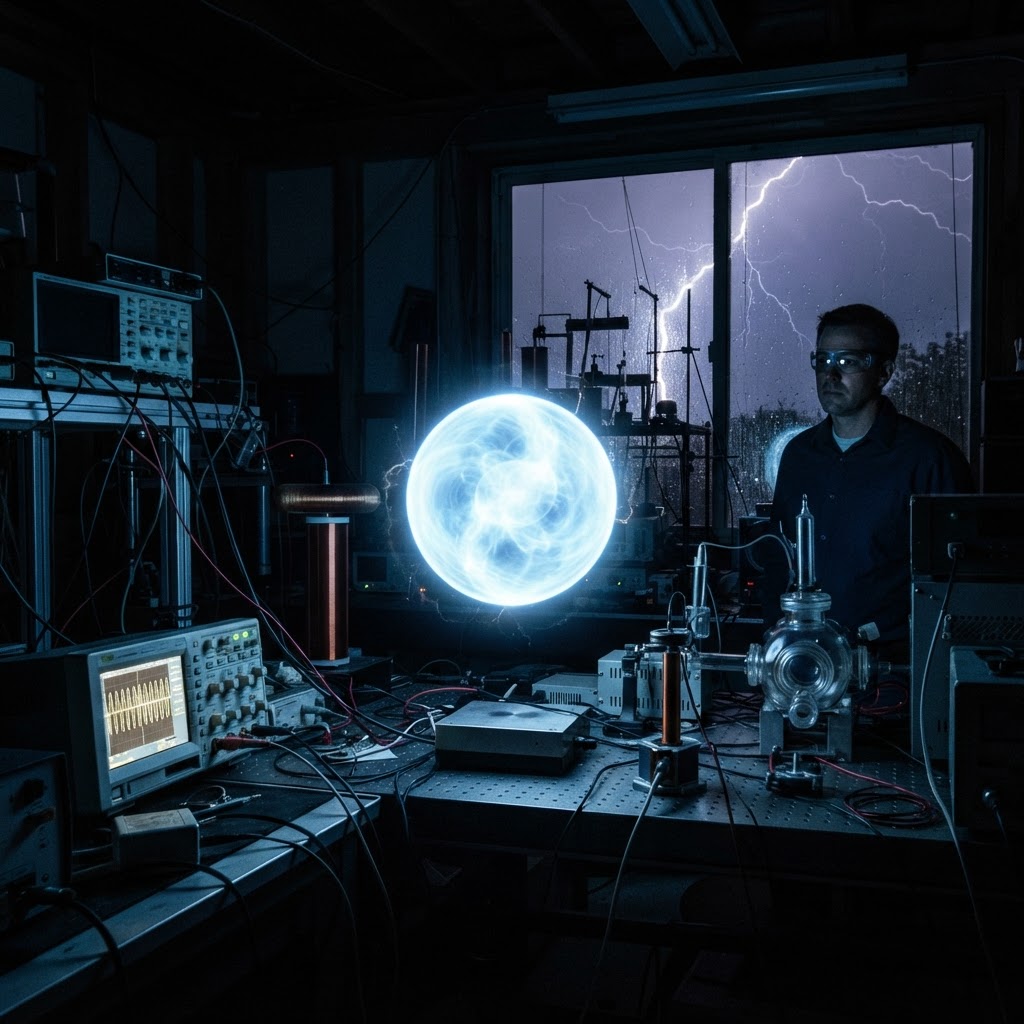
There are three structural obstacles. First, rarity and randomness: events are infrequent and unpredictable, so instrumented captures are rare. Second, heterogeneity: accounts vary—some reports indicate high energy and damage, others mild, slow fades—suggesting more than one phenomenon may be called "ball lightning." Third, reproducibility: laboratory attempts have produced luminous balls under constrained conditions (e.g., microwave discharges, electrode explosions, and combustion of metal powders) but none convincingly reproduce the combination of behaviors seen in the field.
Recent shifts and pragmatic paths forward
Two developments improve prospects. Consumer cameras and dashcams have generated more candidate videos, allowing spectral and motion analyses that were impossible decades ago. Meanwhile, systematic lab programs create controlled plasmoids and study the role of nanoparticles, microwaves and aerosol chemistry. The right approach is pluralistic: test multiple mechanisms against quantitative constraints (lifetimes, spectra, emitted heat, interaction with materials) rather than against narrative reports.
Why it matters
Ball lightning is more than a curiosity. It sits at the intersection of atmospheric electricity, plasma physics, and aerosol chemistry. Solving it would fill a conceptual blind spot about how thunderstorms couple to matter, and might reveal new regimes of long‑lived, low‑temperature luminous plasmas with technical applications.
Bottom line
Ball lightning is a real but heterogeneous set of phenomena that exposes the limits of our observational coverage. The field needs instrumented, reproducible cases and the discipline to accept multiple mechanisms where warranted. Until then, the glowing sphere remains a stubborn, instructive enigma.