Introduction: a surprise in the sky
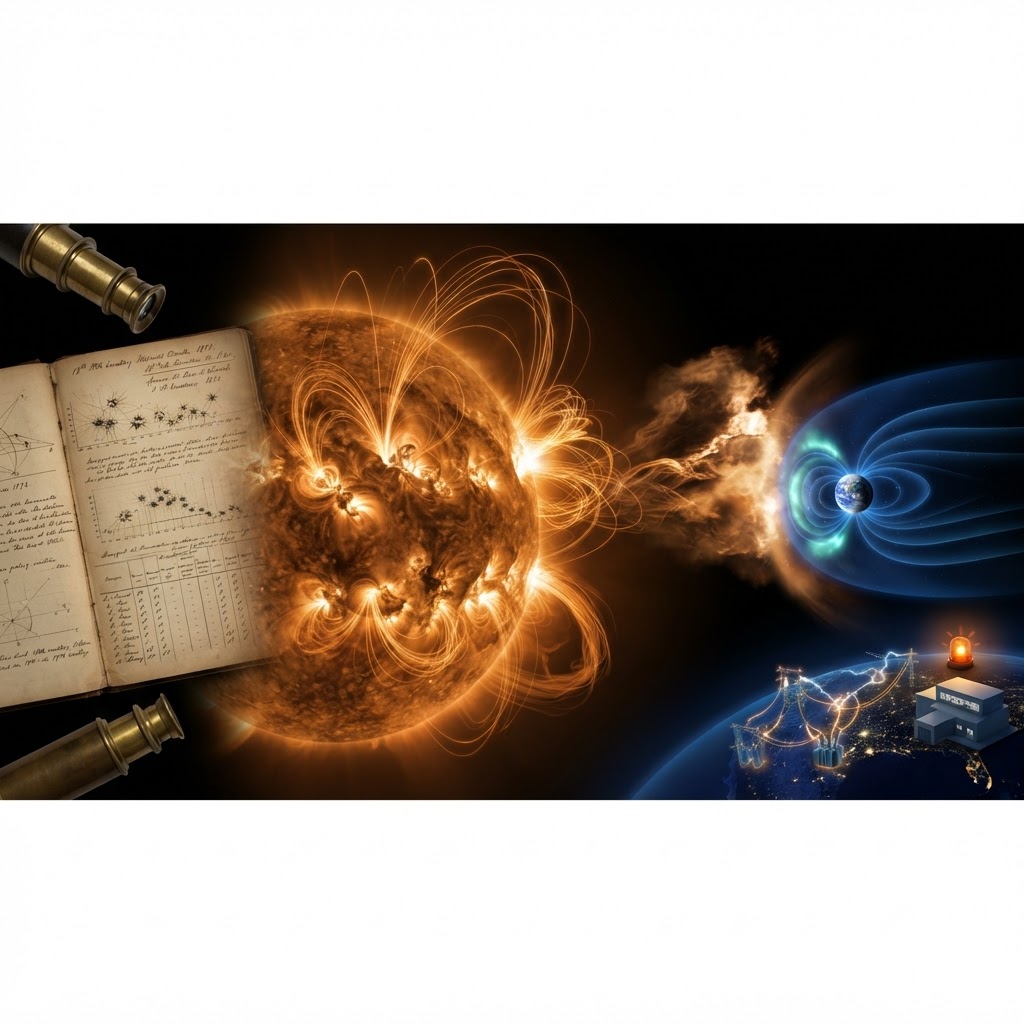
On a September afternoon in 1859 Richard Carrington sketched a white-light flare on the Sun and, within hours, auroras exploded as far south as the Caribbean. Telegraph systems faltered; operators felt electric shocks. That connection between a violent solar outburst and terrestrial disruption was startling and set generations of scientists—Kristian Birkeland among them—on a quest to understand the Sun–Earth link. The twentieth century’s space age transformed that quest into an observational science: we discovered a stream of charged particles (Eugene Parker’s solar wind), measured magnetic storms in near-Earth space, and finally—thanks to coronagraphs on spacecraft—watched entire clouds of plasma hurl off the Sun. Those clouds came to be called coronal mass ejections, or CMEs, and when they meet each other en route to Earth the consequences can be unexpectedly fierce.
What happens when CMEs collide?
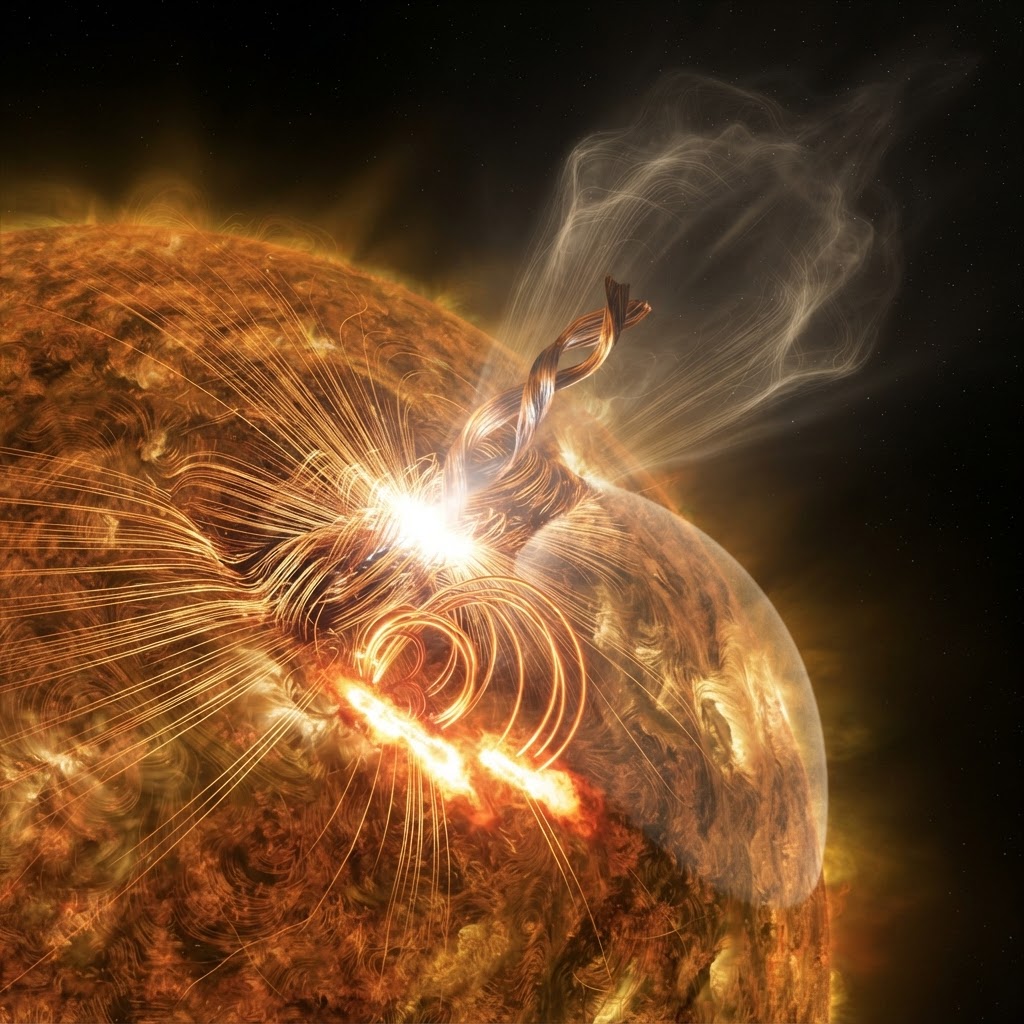
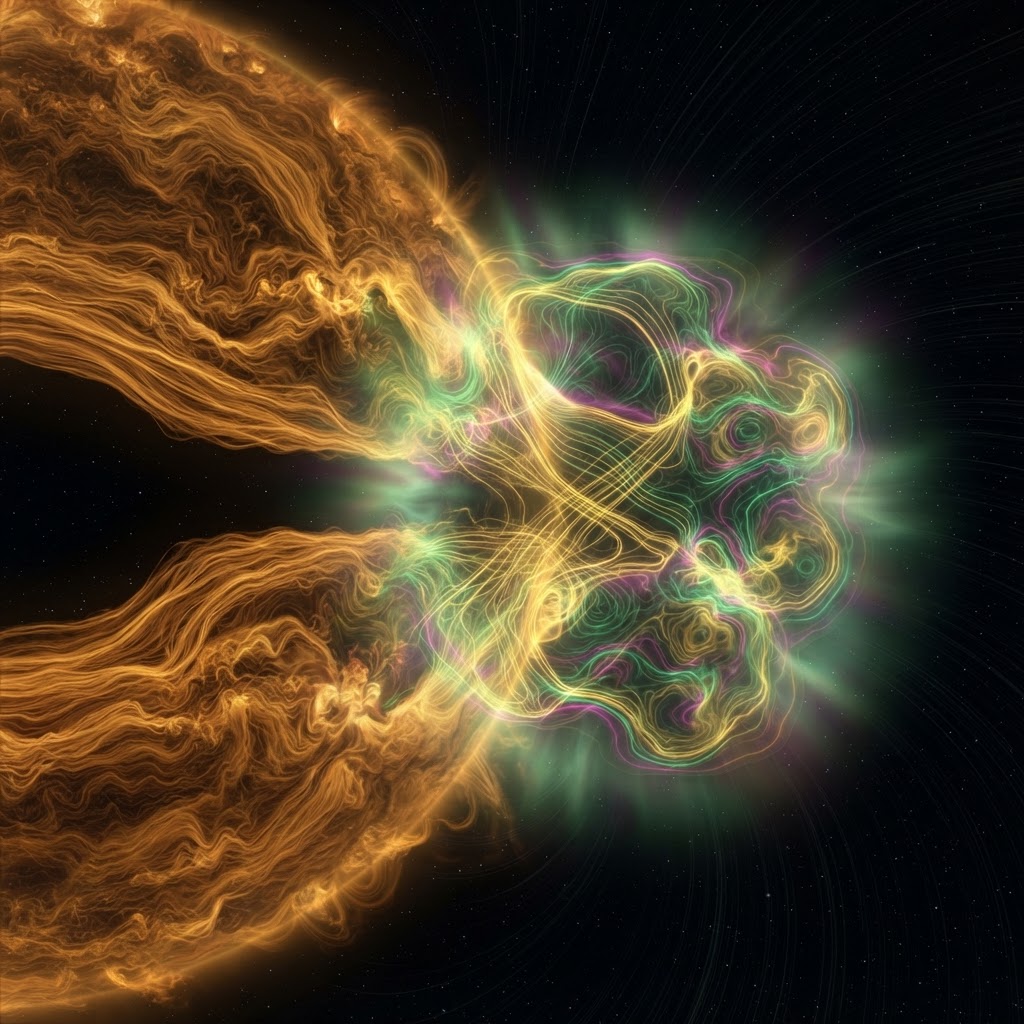
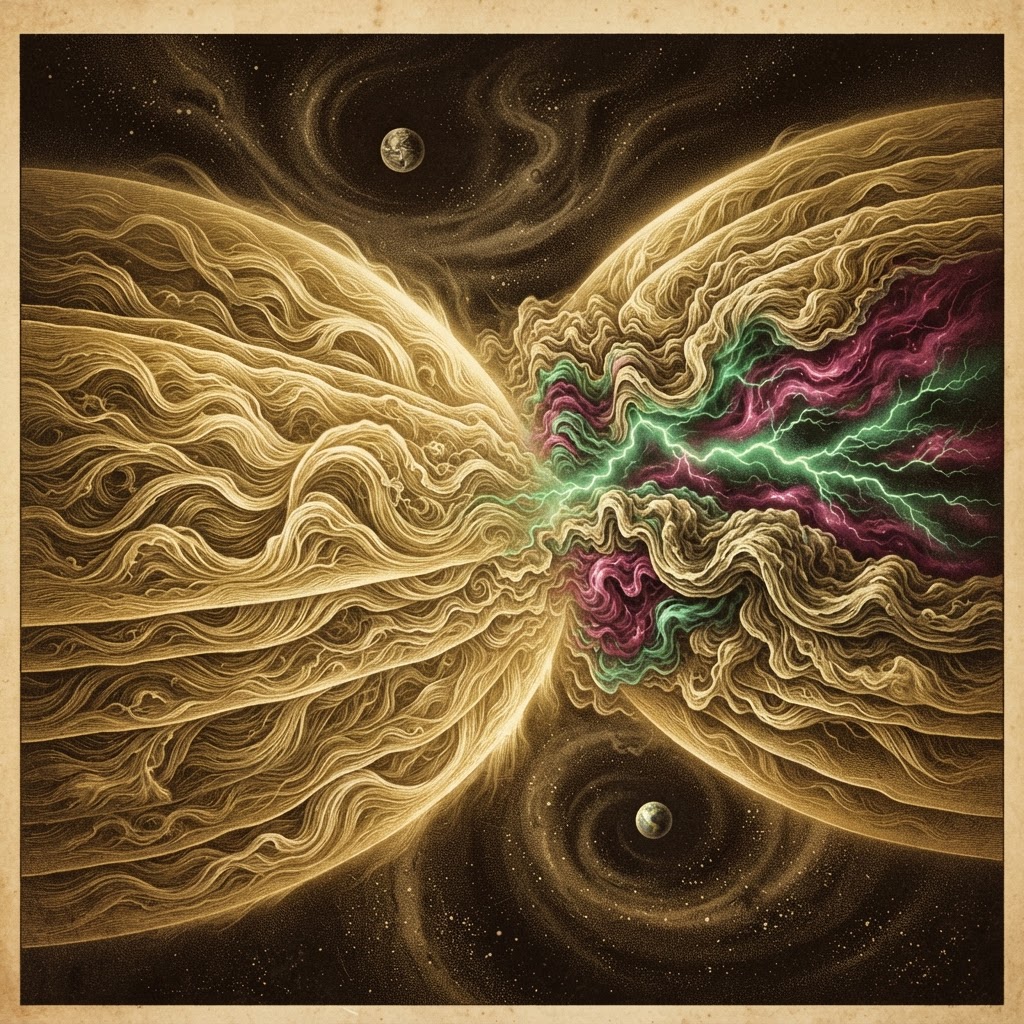
A single CME is a billion-ton bubble of magnetized plasma that expands into the heliosphere at hundreds to thousands of kilometers per second. If one CME leaves the Sun shortly after another, the faster one can catch the slower ahead. That encounter is not a gentle merging of clouds; it is a dynamic interaction that may involve shock fronts, compression, magnetic reconnection and the formation of a merged or compound structure often called an interplanetary coronal mass ejection (ICME) or a complex ejecta.
Why collision makes storms worse:
- Compression amplifies magnetic field strength and plasma density, increasing the ability of the solar wind to drive currents in Earth’s magnetosphere.
- Shock–shock interactions produce strong upstream turbulence and energetic particles, which can penetrate and disturb satellites and radiation belts.
- Reconfiguration of magnetic fields during interaction may produce prolonged intervals of southward magnetic field (Bz), the orientation most effective at coupling solar wind energy into Earth’s magnetosphere and generating geomagnetic storms.
A short history of discovery
Early spaceborne coronagraphs on Skylab and later missions in the 1970s established that CMEs are common. In the 1980s and 1990s researchers such as R. Bruno Burlaga identified magnetic clouds, coherent, twisted magnetic structures within ICMEs. The deployment of the Large Angle and Spectrometric Coronagraph (LASCO) on SOHO in 1996 produced an explosion of CME catalogs and showed how frequently eruptions occur in clusters. The twin STEREO spacecraft in the 2000s then gave us three-dimensional views of CME evolution and direct evidence of overtaking and deflection when CMEs interact.
Perhaps the clearest public demonstration came during the October–November 2003 "Halloween" storms: a sequence of powerful CMEs produced a compound storm that caused satellite anomalies, disrupted radio communications and induced currents that temporarily blacked out Quebec in 1989—an earlier, single-CME event had already shown the vulnerability of power grids.
Why it was revolutionary
The realization that solar eruptions do not act as isolated bullets but as members of a messy, interacting ensemble changed both our physical picture and our practical approach. It forced a shift from simple one-to-one forecasting (one flare, one arrival) to a systems perspective: the heliosphere is a medium where structures interact and change unpredictably. This was a major conceptual leap akin to recognizing that weather systems on Earth interact to create extremes—only the scales and forces differ.
Why it matters now
Human society now depends on satellite communications, precise navigation, and high-voltage power networks that are sensitive to geomagnetically induced currents. Compound storms produced by CME–CME interactions can be stronger, longer-lasting and more unpredictable than single-CME events. They increase the risk to satellites, human spaceflight, radio-dependent infrastructure and terrestrial power systems. Better understanding these interactions is therefore not an academic pursuit; it is an investment in resilience.
The present frontier
Modern work combines remote sensing from SOHO, STEREO and SDO with in-situ solar wind measurements from ACE, Wind and DSCOVR, and with increasingly sophisticated numerical models. Researchers are learning how collision parameters—relative velocity, magnetic orientation, timing and the background solar wind—determine whether CMEs will merge benignly or produce a compound storm. Yet a stubborn gap remains: predicting the magnetic field orientation that arrives at Earth, especially after complex interactions, is still the limiting factor in forecasting storm strength.
Conclusion: watching the Sun’s traffic
The story of CME–CME interactions is one of gradual revelation—from Carrington’s sketch to real-time heliospheric imaging—and it ties together plasma physics, magnetism and practical concern for modern technology. As we put more of our infrastructure into space and as human presence beyond low Earth orbit grows, understanding how solar tsunamis collide will be central to keeping our lights on and our explorers safe. The Sun’s eruptions are dramatic and beautiful; their interactions teach us humility about prediction and urgency about preparedness.