The Thermodynamic Arithmetic of Decoherence
The thermodynamic cost of maintaining a quantum superposition in a warm, wet, and noisy biological environment is exacted in decoherence time, and the bill is always due. To understand why quantum biology is a functional reality while quantum consciousness remains a mathematical abstraction, we must look at the arithmetic of this decoherence bill. The primary constraint is the interaction between a quantum system and its thermal reservoir, which forces the collapse of coherent wave functions at rates typically measured in picoseconds or faster. In the radical-pair mechanism of avian magnetoreception, the relevant energy scale is a ~50 µT Zeeman interaction (established), which modulates singlet-triplet interconversion before thermal noise can scramble the spin state. The system works not because it sustains macroscopic coherence, but because the quantum state is read out as a population statistic rather than a phase. Quantum biology is not a single monolithic claim; it is a family of mechanisms that share a strict design principle: they exploit transient, geometrically protected, or statistically averaged quantum effects rather than attempting to isolate a global coherent state.
The efficacy of these mechanisms depends entirely on the ratio between the coherent lifetime of the state and the decoherence time imposed by the surrounding bath. By operating on time scales where the system performs a specific task—such as charge separation or barrier crossing—before thermal energy can effectively sample the quantum state, life bypasses the decoherence bottleneck. This avoidance strategy suggests that biological evolution has navigated the Hilbert space of possible molecular geometries to maximize phase coherence for just long enough to transduce a signal. Consequently, quantum biology succeeds by leveraging decoherence as a mechanism for output, rather than treating it as a failure of system maintenance. The distinction is between a system that suppresses noise to protect a state and one that uses the noise to resolve a state.
The Three Canonical Pillars of Environmental Avoidance
The three canonical pillars of quantum biology all rely on this principle of environmental avoidance. In photosynthetic pigment-protein complexes, exciton coherence operates on the femtosecond scale (established). Early reports of long-lived electronic coherence have undergone an honest and necessary revision: much of the oscillatory signal previously attributed to electronic superposition has been reassigned to vibrational coherence (measured; interpretation contested). The system uses quantum effects to find the optimal energy transfer pathway, but it does so before the thermal bath can collapse the wave function. This energy transfer pathway optimization allows for near-unity quantum efficiency, a feat that would be thermodynamically impossible through classical hopping alone. The consequence is a highly efficient metabolic engine that achieves rapid photon-to-charge conversion while avoiding the thermal loss characteristic of dissipative non-quantum pathways.
Similarly, in enzyme catalysis, proton tunnelling—such as that observed in dihydrofolate reductase—is evidenced by massive kinetic isotope effects (established). The enzyme does not maintain a long-lived superposition; it simply compresses the reaction barrier enough to allow the proton to tunnel through it instantaneously. This compression reduces the time the proton spends in the barrier region, effectively minimizing the chance of environmental coupling and decoherence. The isotope effect is a direct measure of the sensitivity of the reaction to the mass of the tunneling particle, confirming that the tunneling probability is significantly higher for protons than for heavier isotopes like deuterium. Thus, the enzyme creates a specialized local environment that facilitates quantum transition while preventing the decoherence that would otherwise inhibit the reaction rate.
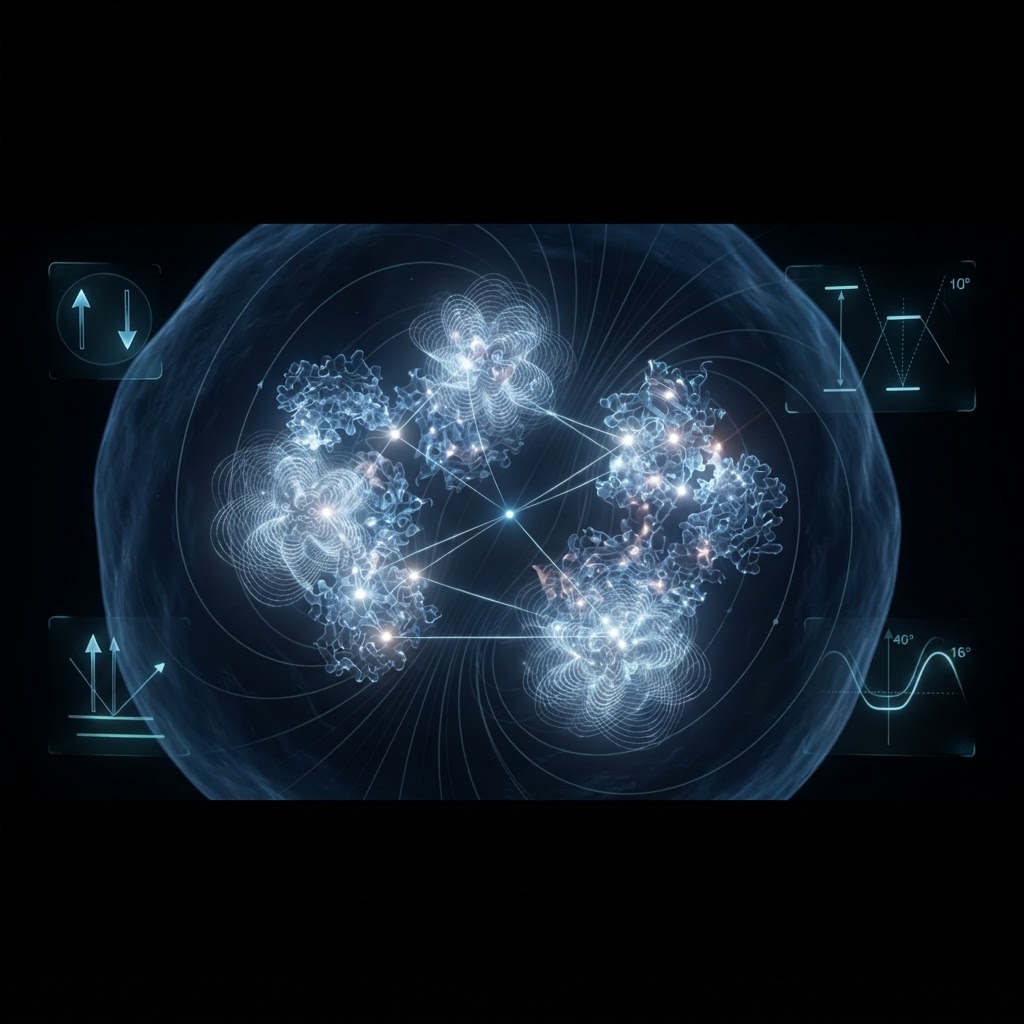
In cryptochrome, the radical-pair mechanism relies on the coherent spin dynamics of a flavin-tryptophan pair. Migratory birds' orientation is disrupted by weak radiofrequency fields, confirming that the ~50 µT geomagnetic field biases the chemical yield of the signaling state before spin decoherence takes over. This indicates that the system is sensitive to the specific orientation of the earth's magnetic field relative to the radical pair axes. The chemical reaction output is essentially a readout of the spin-state population, transforming a subtle quantum interaction into a macro-scale neural signal. The mechanism provides a high-fidelity compass because the quantum spin state is locked to the geometry of the protein environment throughout the brief duration of the electron transfer process.
Human Magnetoreception and Neural Correlation
The frontier of this field has recently shifted to human magnetoreception. Cryptochrome 2 is expressed in the human retina, and recent experiments in magnetically shielded chambers report electroencephalography (EEG) alpha-band desynchronization in response to the slow rotation of a ~50 µT magnetic field (measured; interpretation contested). It is crucial to state clearly what is measured versus what is inferred: the EEG amplitude drop is a measured neural correlate to field rotation, but the transduction mechanism is not secured. The researchers noted that the response was sensitive to the polarity of the field, which actually argues against a pure radical-pair "quantum compass" (which detects only axial alignment) and points toward magnetite, though the debate remains open. If the sensor were purely radical-pair based, the system would exhibit identical responses to 180-degree field flips, whereas polarity sensitivity implies a magnetic moment-based alignment. Replication and a definitive molecular mechanism are not yet secured, demanding rigorous skepticism without dismissive sneering.
The distinction between magnetoreception mechanisms (quantum-mechanical spin-dependent chemistry vs. classical torque on magnetite particles) is not merely semantic; it carries profound implications for the physiological energy requirements of the sensory system. A radical-pair compass, while computationally efficient in its signal transduction, requires biological light sensitivity and high-efficiency electron transfer. In contrast, a magnetite-based system would operate on mechanical force and ion channel gating. The current evidence of EEG desynchronization acts as a potential neural trigger, but we lack the intermediate link between the magnetic influence and the electrical potential changes seen at the scalp. This creates an ambiguity: we have a behavioral potential and a neural correlate, but no established causal chain between quantum interaction and the observed cortical response.
The Constraints of DNA and Tubulin Coherence
Beyond sensory transduction, coherent electron transfer in DNA has been extensively documented. Hole hopping through guanine stacks exhibits a shallow distance dependence characteristic of quantum transport (established). However, DNA charge transport is a mechanism for damage sensing and repair signaling, not a computational resource. The coherence is strictly local and transient, serving a structural and chemical function rather than processing information in the computational sense. Because this process is restricted to electron migration along the base pairs, it does not require, nor does it support, long-range biological integration. The decoherence occurs as soon as the electron encounters a trap or the surrounding solvent, limiting the scope of any potential quantum information storage to the scale of individual base stacks.
This brings us to the cytoskeletal and brain-scale quantum computation models, most notably Orchestrated Objective Reduction (ORCH-OR). ORCH-OR is a serious model, but it possesses a specific, quantifiable vulnerability: decoherence estimates. Max Tegmark's foundational critique placed the decoherence time of tubulin superpositions near 10^-13 seconds (model-dependent). This is orders of magnitude below the 10^-2 to 10^-1 seconds required to couple with gamma-cycle-timescale neurophysiological events. The Penrose-Hameroff school's rebuttals turn on specific physical shielding mechanisms: actin gel screening, hydrophobic pocket geometry, Debye shielding, and coherent nuclear spins in lattice water (speculative — flagged). This is a legitimate disagreement about the model's physical setup, not just the arithmetic. The argument hinges on whether the biological architecture can effectively isolate the tubulin states from the thermal bath. Settling this requires direct, ultrafast spectroscopic measurement of tubulin dimer superposition lifetimes in physiological buffer, not just theoretical modeling.
The Quantum Zeno Model of Consciousness
Henry Stapp's Quantum Zeno model of consciousness posits that rapid, repeated conscious observations freeze the evolution of the brain's quantum state via the Quantum Zeno effect (speculative — flagged). While mathematically consistent with von Neumann's formulation of quantum mechanics, the model lacks a critical physical term: an identified, physical measurement interaction occurring at the required rate to induce the Zeno effect without invoking a dualistic observer. Without this physical coupling term, the model remains a philosophical interpretation rather than a testable biophysical mechanism.
The Superradiance Interpretation and Computational Limits
The most misreported result in this space is the 2024 observation of ultraviolet superradiance from mega-networks of tryptophan in microtubule architectures. Babcock and colleagues demonstrated that anaesthetics quench this superradiance, and that intact microtubules exhibit enhanced fluorescence quantum yields compared to free tubulin (measured; interpretation contested). It is vital to explain precisely what this means. Superradiance is a collective emission effect where a network of chromophores couples to the electromagnetic vacuum, emitting a photon faster and more intensely than isolated molecules. It is a quantum optical phenomenon, but it is not sustained coherence. It has a very short lifetime and is essentially a decay process. This makes the result fascinating—it proves that microtubule architecture supports collective quantum optical states—but it is insufficient to support the sustained, millisecond-scale coherence required for ORCH-OR computation. It is a structural reality, not a computational one. The distinction is foundational: while the collective state shows that microtubules can behave as optical cavities, the lack of long-lived maintenance means the system lacks the temporal stability to perform logic gates.
| Phenomenon | Coherence Time / Energy Scale | Environmental Interaction | Evidentiary Status |
|---|---|---|---|
| Photosynthetic Exciton Transfer | Femtosecond scale | Thermal bath drives rapid decoherence; system exploits transient state. | Established (vibrational/electronic debate ongoing) |
| Enzyme Proton Tunnelling | Instantaneous barrier crossing | Protein scaffold compresses barrier; no sustained superposition. | Established (Kinetic Isotope Effects) |
| Cryptochrome Radical-Pair | ~50 µT Zeeman interaction | Spin state read out as chemical yield before thermal scrambling. | Established in birds; contested in humans |
| Microtubule UV Superradiance | Picosecond emission scale | Rapid collective decay to the electromagnetic vacuum. | Measured; interpretation contested |
| ORCH-OR Tubulin Coherence | 10^-13 s (Tegmark) vs 10^-1 s (Hameroff) | Debated: Thermal bath vs. Debye shielding and lattice water. | Speculative — flagged |
What would change our mind
The thesis that brain-scale quantum computation is precluded by decoherence is falsifiable. The following concrete, feasible measurements would force a revision of this stance:
- Direct measurement of millisecond tubulin coherence: Two-dimensional electronic spectroscopy (2DES) of intact microtubules in physiological buffer demonstrating electronic or nuclear spin coherence lifetimes exceeding 10^-3 seconds. Such a measurement would demonstrate that the proposed biological shielding is effective at protecting quantum states far beyond the conventional limit of thermal environmental coupling.
- Isotope-dependent anesthetic efficacy: A behavioral or electrophysiological study showing that the potency of a volatile anesthetic is significantly altered by substituting its atoms with heavier isotopes (e.g., Xenon isotopes with different nuclear spins), which would implicate nuclear spin coupling in the mechanism of consciousness. This result would indicate that the anesthetic action depends on the specific spin properties of the nuclei, suggesting that consciousness is directly linked to coherent spin-lattice interactions.
- Isolation of the human magnetoreception transducer: Identification and structural characterization of a specific protein complex in human tissue that demonstrates magnetic field-dependent chemical yields at 50 µT in vitro, matching the polarity-sensitive EEG responses observed in vivo. Proving such a transducer exists would bridge the gap between quantum chemical sensitivity and whole-organism sensory experience.