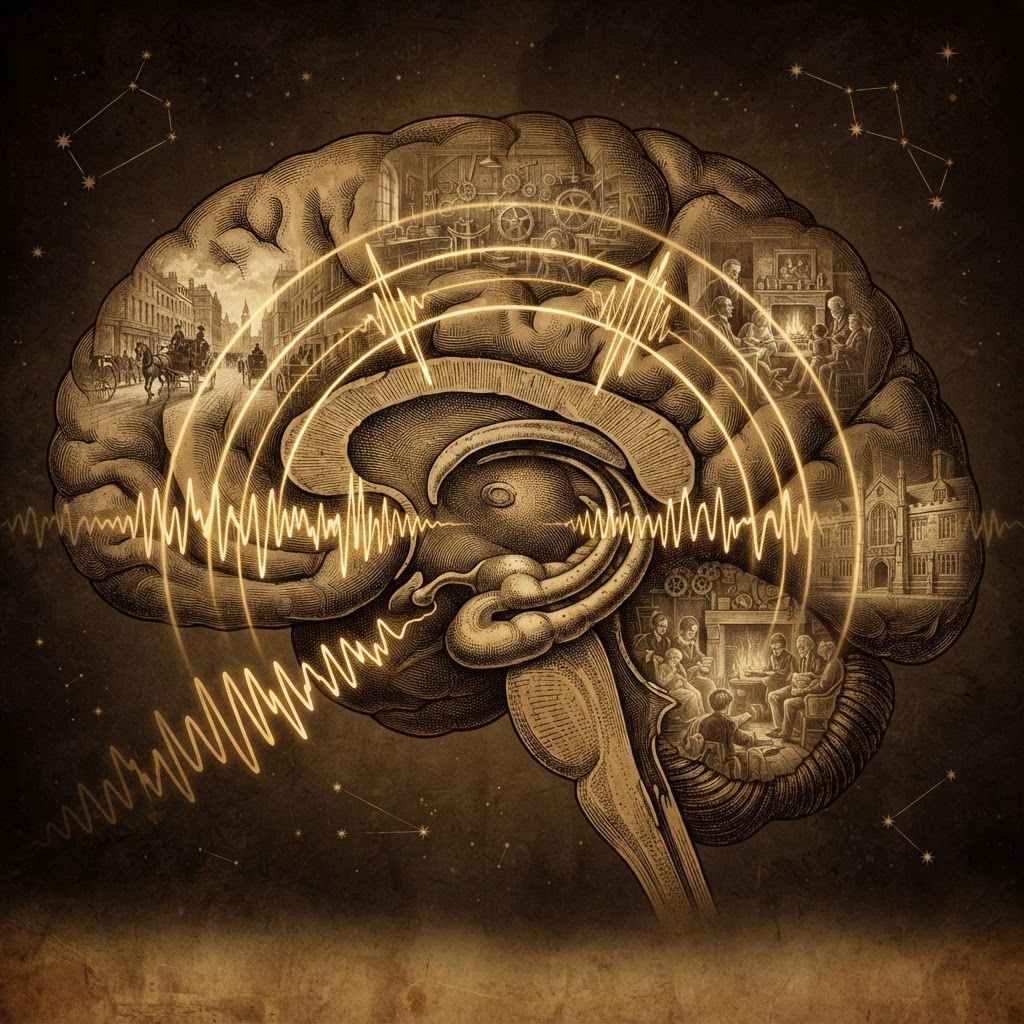
The default mode network (DMN) was once defined largely by what happened when people stopped doing a task: a set of interconnected brain regions became more active during rest and often less active during externally directed work. That framing made the network sound passive—an internal screensaver running between acts of cognition.
Recent neuroscience points to a more consequential role. The DMN appears to help integrate information across extended stretches of time, linking memories, current perceptions, imagined futures, and abstract knowledge into coherent models of people and events. Rather than merely switching on when the outside world becomes less demanding, it may help determine what the present means in light of what came before and what could happen next.
From snapshots to unfolding events
Many laboratory tasks measure cognition in brief, isolated trials. But real thought is rarely organized that way. Understanding a conversation, following a story, planning a journey, or recognizing a familiar person requires information to be accumulated over seconds, minutes, or longer.
Neuroimaging studies increasingly find that DMN regions—including the medial prefrontal cortex, posterior cingulate cortex, angular gyrus, and medial temporal structures—represent information at relatively broad temporal scales. Activity in these areas can reflect the gist of an episode or narrative, even as sensory regions track rapidly changing details. The network’s apparent slowness may therefore be a feature, not a limitation: it provides a stable context into which momentary signals can be inserted.
This temporal layering helps explain why the DMN is engaged during autobiographical memory, scene construction, social reasoning, and narrative comprehension. These abilities all require the brain to move beyond the immediate stimulus. A remembered conversation is not a list of sounds; it is an event with causes, consequences, intentions, and emotional meaning.
A network for latent structure
One influential interpretation is that the DMN encodes “latent” variables—underlying situations or concepts that are not directly present in the sensory input. During a film or story, for example, the network may track the evolving identity of a character, the setting of an episode, or the broader goal driving a sequence of actions. Such representations can remain relatively stable while the details change.
Work using naturalistic stimuli has made this view especially prominent. When participants watch the same film or listen to the same narrative, activity patterns across higher-order regions can align over time. The alignment is not simply a response to identical sounds or images. It appears to reflect shared interpretation: the construction of a common event structure.
Other studies suggest that the DMN also contributes to temporal abstraction during rest. When people recall the past or imagine the future, neural patterns may reinstate elements of earlier experience while recombining them into new scenarios. The network thus operates less like a storage locker than a generative workspace, compressing experience into reusable models.
Why the debate remains open
The temporal-integration account is powerful, but it does not make the DMN a single-purpose “time machine.” Its regions perform overlapping functions, and their contributions vary with task demands, attention, memory, and the level of abstraction required. Some apparent network-level effects may also reflect interactions with the hippocampus, frontoparietal control systems, and sensory cortices rather than activity generated by the DMN alone.
Researchers are now testing whether temporal integration is a core computational principle of the network or a consequence of its participation in memory and conceptual processing. Methods that combine high-resolution imaging, electrophysiology, computational modeling, and naturalistic tasks may help distinguish these possibilities.
The emerging picture is nevertheless clear enough to revise the old metaphor. The default mode network is not the brain at rest. It is part of the machinery that turns successive moments into episodes, episodes into models, and models into a usable sense of self and world.