Prologue: A boundary that refuses to be ordinary
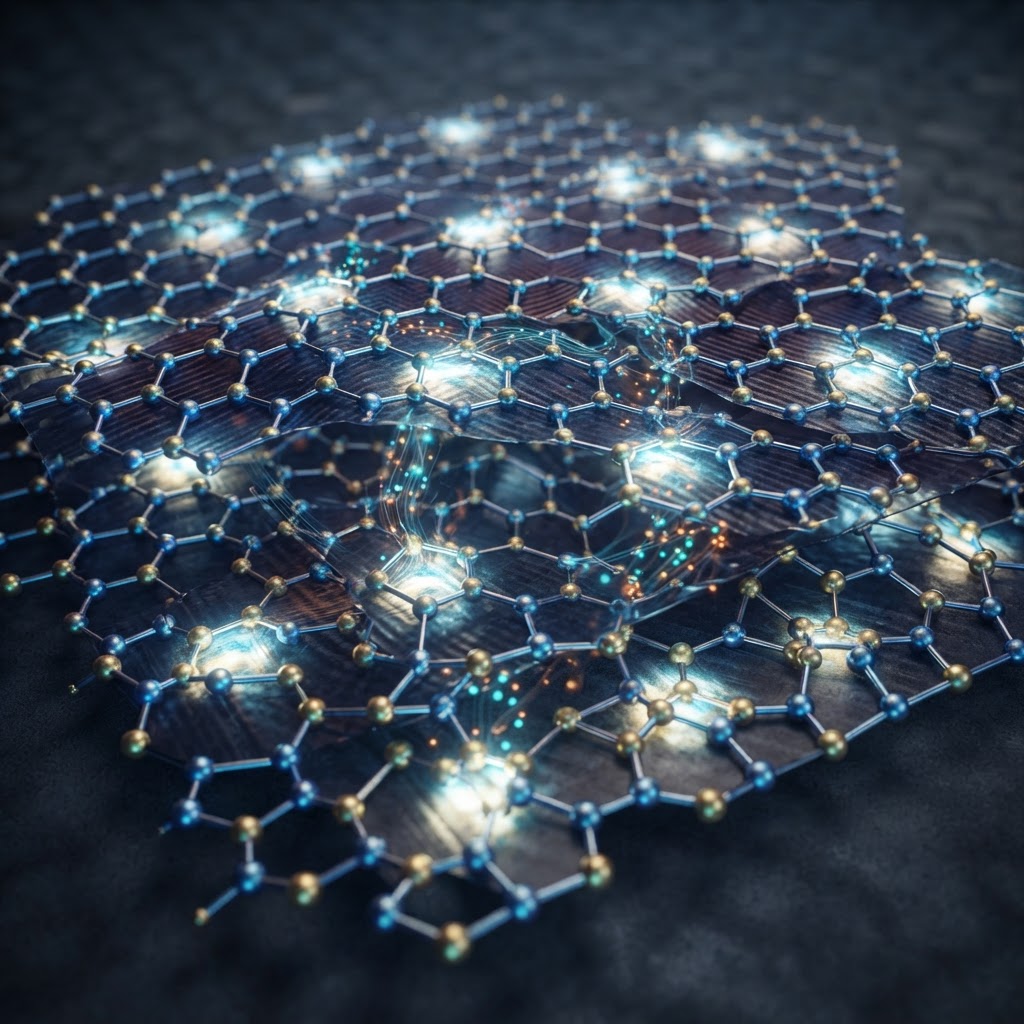
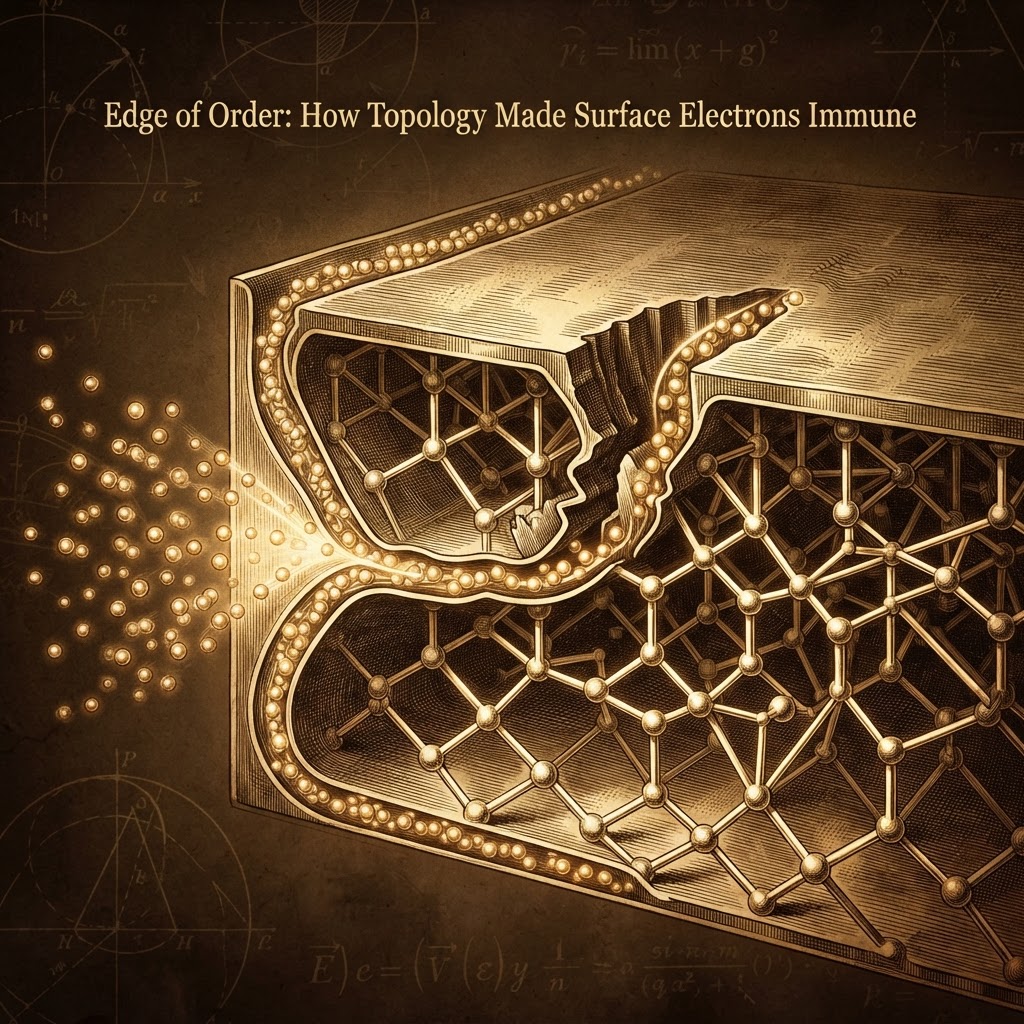
Imagine a sheet of material whose interior is a calm sea of electrons — insulating, inert — but whose boundary is a churning shoreline of perfectly conducting waves. Those waves, the electrons living on the surface or edge, do not scatter away when the shoreline becomes rocky; they bend, flow, and keep moving, protected by an abstract property of the sea itself. That is the striking intuition behind topological insulators: phases of matter whose conducting surfaces are not accidents of chemistry but consequences of topology.
Roots: from quantum Hall to topological order
The story begins with the quantum Hall effect in the early 1980s, when Klaus von Klitzing's discovery of quantized conductance revealed that conductance could be a precise, integer-valued property of a whole sample. Theoretical work by Thouless, Kohmoto, Nightingale, and den Nijs (the TKNN paper, 1982) connected that integer to an invariant of electron bands — a topological number — showing that global properties of wavefunctions can control measurable responses.
Then in 1988 Duncan Haldane proposed a model in which a lattice could display a quantized Hall conductance without an applied magnetic field, teasing out the idea that topology could arise from band structure alone. These were the conceptual seeds that would bloom into a new classification of phases not by broken symmetry but by topology. The 2016 Nobel Prize to David Thouless, Duncan Haldane, and Michael Kosterlitz recognized this deep reconception of phases of matter.
The breakthrough: spin, symmetry, and the Z2 revolution
Topological insulators as we now encounter them in laboratories were theorized when spin-orbit coupling and time-reversal symmetry were recognized as new handles to craft protected surface states. In a pair of papers in 2005, Charles Kane and Eugene Mele introduced the Z2 topological invariant, showing that a two-dimensional crystal with strong spin-orbit interaction could host counterpropagating, spin-filtered edge modes — the quantum spin Hall effect — immune to non-magnetic disorder.
Following that insight, Bernevig, Hughes, and Zhang proposed that mercury telluride quantum wells should display this behavior; experiments by Konig and colleagues in 2007 confirmed it. Within a few years, three-dimensional topological insulators were identified experimentally in bismuth-based compounds by teams led by Hasan and Hsieh, whose angle-resolved photoemission spectroscopy (ARPES) images revealed the hallmark Dirac cone — a linear, robust surface band crossing the bulk gap.
Why the surface is protected
The crux is topology plus symmetry. In a topological insulator the bulk bands undergo a band inversion driven by spin-orbit coupling. That inversion changes a global mathematical property — the Z2 invariant — distinguishing that band structure from a trivial insulator. At the interface between regions of different topology, the electronic structure must interpolate; the only way to do so is to produce gapless states at the boundary. Time-reversal symmetry prevents those states from being gapped out by ordinary (non-magnetic) disorder. As a result, backscattering is suppressed: an electron cannot flip both direction and spin without breaking time-reversal symmetry, so the surface transport becomes unusually robust.
What this changed
- A new classification of matter: topology joins symmetry as a principle for organizing phases of matter.
- Robust transport: surface and edge channels that resist localization offer routes to low-dissipation electronics and spin-based devices.
- Platform for exotic states: interfacing topological insulators with superconductors can nucleate Majorana modes — candidates for fault-tolerant qubits.
Present and future
Topological insulators remain a fertile crossroads between abstract mathematics and practical engineering. Materials chemistry is learning to tune spin-orbit effects and chemical potential; device engineers are building heterostructures that combine topology with magnetism and superconductivity; theorists are mapping ever richer topological classifications, including higher-order and crystalline topological phases. The challenge is turning exquisite ARPES images and low-temperature transport signatures into robust, scalable technologies.
Epilogue: why it matters
What makes the story of topological insulators enduring is its blend of conceptual elegance and technological promise. A principle rooted in abstract invariants — once the province of pure mathematics — now dictates whether electrons on a material's surface will turn roughness into resistance or immunity. That surprising bridge between geometry and electronics reshapes how we design materials and devices, and it continues to push the frontier of what matter can do.