What glass is — and how we make it
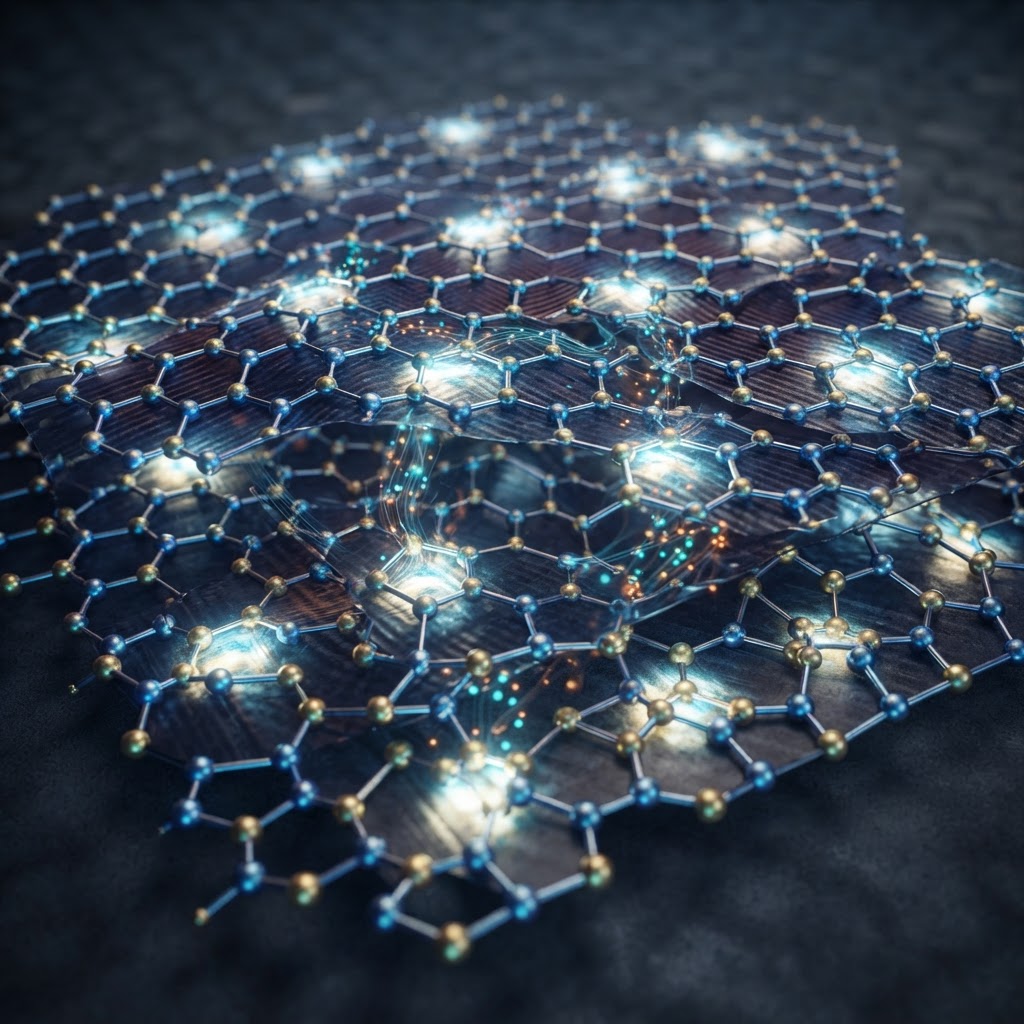
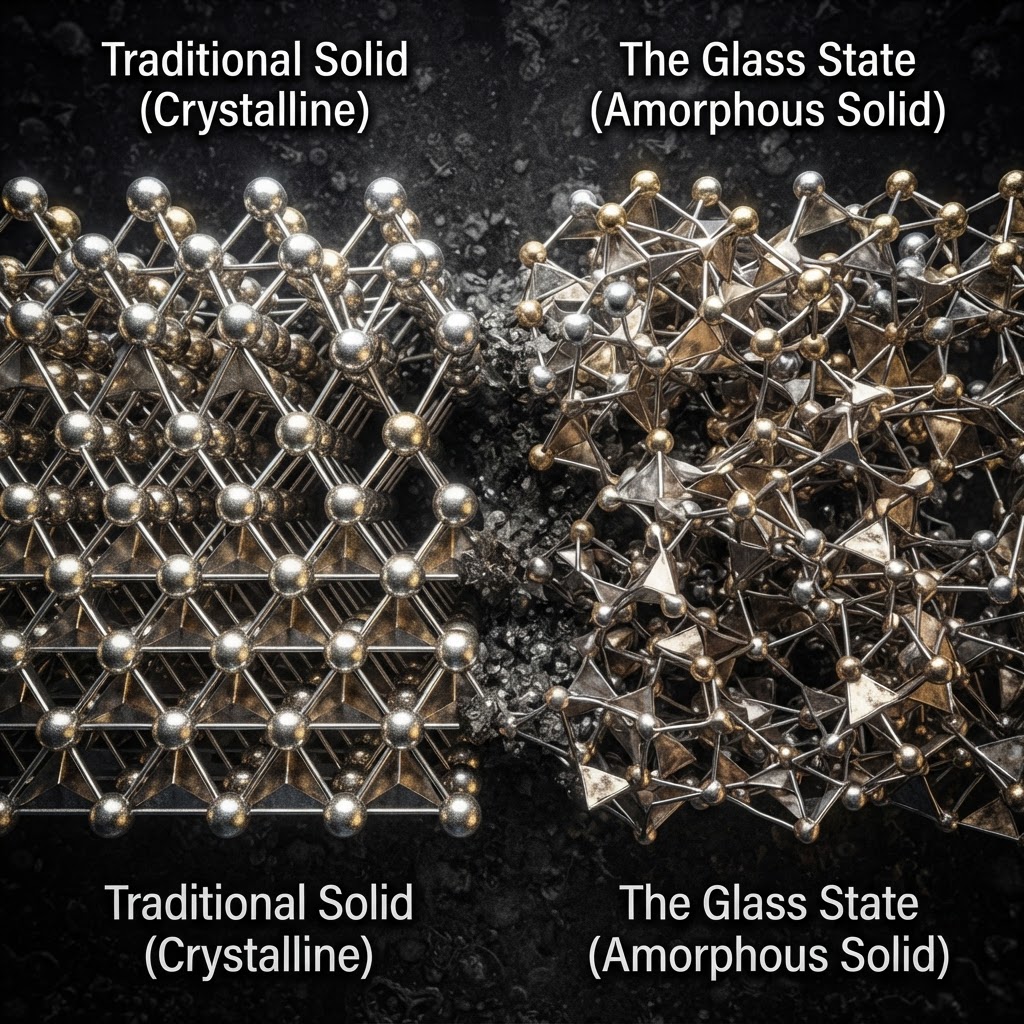
Most industrial and artisan glasses begin life as a molten mix of silica, fluxes (soda, lime) and additives. Heaters drive the mixture above 1,300 °C until it flows as a homogeneous liquid. The material is then cooled. If cooling is slow and conditions favor order, atoms arrange into a crystal; if cooling is fast or composition disfavors crystallization, the structure becomes amorphous — atoms frozen in a disordered arrangement. That arrested, non‑crystalline structure is what we call glass.
Manufacturing controls — cooling rate, additives, and annealing protocols — determine glass properties. Industrial float glass, container glass and specialized optical glasses use controlled cooling and reheating (annealing) to remove internal stresses and tune mechanical and optical performance. In research labs, vapor deposition and ultrafast cooling make glasses with exceptional stability and unusual physical properties.
Neither solid nor liquid — a useful paradox
The everyday intuition that glass is a solid is correct in terms of rigidity: a window doesn’t sag under its own weight. But that apparent solidity is not the same as the rigidity of a crystal. In crystals, long‑range periodic order fixes positions of atoms in space; defects and thermal vibrations are small perturbations. Glass lacks periodic order. Its rigidity is kinetic: the atoms are trapped in a disordered arrangement because their motions have slowed dramatically during cooling.
Physicists therefore call glass a non‑equilibrium amorphous solid. The key phrase is non‑equilibrium: a glass is not the lowest‑energy state for its composition (a crystal typically is), it is simply what the system reached given the dynamical constraints of cooling. On long enough timescales — or at higher temperatures — the glass would relax and flow like a liquid.
What recent work has clarified
- Ultrastable glasses: Physical vapor deposition can assemble glasses layer by layer so molecules reach low‑energy configurations before they are buried. These "ultrastable" glasses exhibit lower enthalpy and far greater kinetic stability than ordinary quenched glasses, demonstrating experimentally that glasses can approach much deeper minima in the energy landscape without crystallizing.
- Advanced simulations: New Monte Carlo techniques (including particle‑swap algorithms) and high‑performance computing now equilibrate model glass formers at temperatures previously unreachable. These studies probe the dramatic growth of viscosity and dynamical heterogeneity, and test theories about whether an underlying thermodynamic "ideal glass" transition exists.
- Renewed theoretical debate: The community is actively testing whether glassiness is purely kinetic (a crossover with no true phase transition) or whether there is a hidden thermodynamic transition at lower temperature. Experiments and simulations are closing the gap between accessible states and the theoretical limits.
What this means practically
For engineers and makers the message is simple: glass is a process product. Its structure and properties depend on how it was made and how long it has aged. For physicists the message is exciting: glass occupies a boundary region of matter where dynamics, disorder and history dominate behavior — and new experimental and computational tools are finally letting us map that territory.
Practical myths fall away too: old cathedral windows do not visibly flow over centuries because glass is a liquid; their uneven thickness reflects historic manufacturing, not slow sagging.