The Invisible Made Thermally Transparent
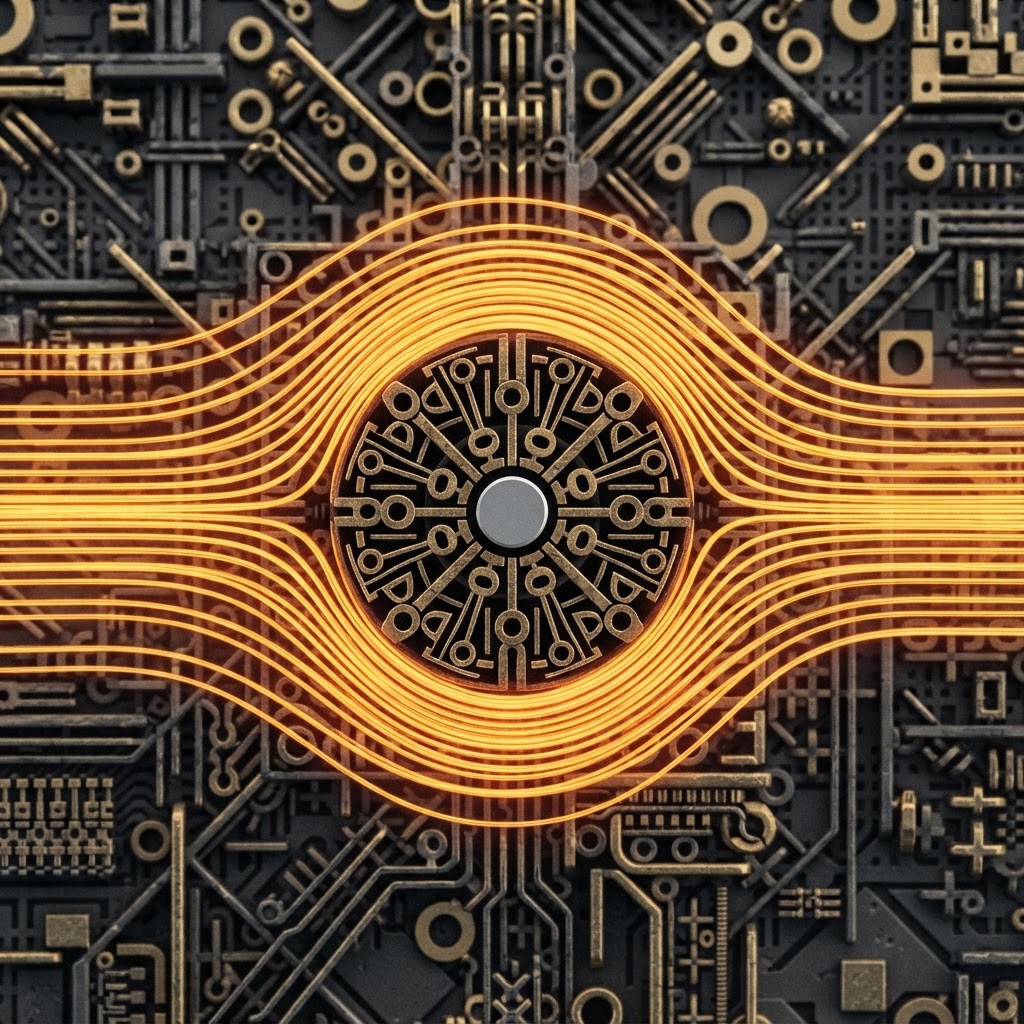
Cloaking, in popular imagination, belongs to the realm of optics — bending light around an object so that it appears invisible. Yet the mathematical framework underpinning optical cloaks, rooted in coordinate-transformation theory, is domain-agnostic. Heat, governed by Fourier's law rather than Maxwell's equations, obeys its own diffusion equation — and that equation can be subjected to precisely the same transformation logic. The result is a thermal cloak: a structured material shell that guides conductive heat flux around a protected interior region, leaving the temperature field downstream indistinguishable from what it would have been in a uniform medium. The object inside is, thermally speaking, not there.
This is not a curiosity. As power densities in semiconductor devices push toward tens of kilowatts per square centimeter, and as thermal management becomes the binding constraint on next-generation electronics, quantum devices, and photonic systems, the ability to sculpt heat flow with spatial precision is emerging as one of the defining materials challenges of the 21st century.
Transformation Thermotics: The Mathematical Engine
The theoretical foundation was laid in 2008, when Fan Chenwen, Yun Lai, and colleagues at the National University of Singapore, building on the electromagnetic transformation-optics framework pioneered by Pendry, Schubert, and Greenleaf, demonstrated that Fourier's heat-conduction equation is form-invariant under coordinate transformations. Specifically, if one maps a region of virtual space (where heat flows uniformly) onto a compressed or expanded region of physical space, the transformed conductivity tensor that results — typically anisotropic and spatially graded — will force heat to follow the prescribed curved trajectories.
The governing equation in steady state is:
∇ · (κ · ∇T) = 0
where κ is the (potentially tensorial) thermal conductivity. Under a coordinate transformation x → x', the conductivity transforms as:
κ' = (A · κ · AT) / det(A)
where A is the Jacobian of the transformation. For a cylindrical cloak that compresses a disk of radius R₂ into an annular shell between radii R₁ and R₂, the required conductivity profile is radially graded, azimuthally anisotropic, and singular at the inner boundary — the conductivity in the radial direction approaches zero at r = R₁, while the azimuthal conductivity diverges. This singularity is the central practical obstacle the field has spent fifteen years trying to negotiate.
From Theory to Tabletop: Early Experimental Demonstrations
The first experimental thermal cloaks appeared in 2012–2014, exploiting two complementary strategies. Schittny and colleagues at Karlsruhe Institute of Technology (2013) built a bilayer cloak from concentric shells of high- and low-conductivity materials — copper and polydimethylsiloxane (PDMS) — arranged so that the effective medium approximated the required anisotropic profile. Their infrared thermography images showed isotherms bending smoothly around the inner cavity, with the downstream temperature gradient restored to near-uniformity. Crucially, no thermal shadow appeared behind the cloak.
Simultaneously, Han and colleagues demonstrated a cloak using natural materials layered in a fan-like geometry that approximated the required radial conductivity gradient through a multilayer homogenization approach. The effective radial conductivity scaled as κr(r) ∝ (r − R₁)/r, achieved by varying layer thicknesses.
These demonstrations were steady-state. The cloaks worked because the diffusion equation in steady state has no characteristic speed — heat simply redistributes until equilibrium is found. Transient cloaking, where the interior also appears thermally invisible during time-dependent heating events, is substantially harder. It requires matching not just conductivity but also the volumetric heat capacity ρcp, complicating material selection dramatically.
Metamaterial Architectures: How Spatial Engineering Replaces Material Exotica
Unlike electromagnetic metamaterials — which require sub-wavelength resonant structures because light has a wavelength to resonate against — thermal metamaterials have no such constraint. Heat diffusion has no wavelength. This is liberating: thermal metamaterials can be fabricated using macroscopic geometric architectures rather than nanoscale resonators.
The dominant strategies fall into three categories:
- Laminate composites: Alternating thin layers of high-conductivity (copper, graphene) and low-conductivity (polymer, aerogel) materials. By varying layer thickness as a function of radius, the effective medium conductivity is tuned continuously. Effective medium theory gives κr = (κ₁d₁ + κ₂d₂)/(d₁+d₂) for the stacking direction and the harmonic mean for the perpendicular, enabling strong anisotropy from isotropic constituents.
- Graded porous architectures: Metal foams or lattice structures with spatially varying porosity. As porosity increases toward the inner boundary, the effective conductivity drops, approximating the singular radial profile. Additive manufacturing has made these geometries accessible at millimeter scale.
- Origami and kirigami thermal structures: Folded or cut sheet metamaterials whose effective conductivity is tunable by folding angle — enabling reconfigurable cloaks whose performance can be adjusted post-fabrication.
The emergence of two-dimensional materials has added a new dimension. Graphene, with in-plane thermal conductivity exceeding 5000 W·m⁻¹·K⁻¹ and near-zero cross-plane conductivity, is a naturally anisotropic thermal conductor. Patterned graphene networks on polymer substrates can be engineered to achieve the anisotropy ratios of 100:1 or greater demanded by cloak designs, at thicknesses below 10 µm.
Beyond Cloaking: Thermal Concentrators, Rotators, and Illusions
Transformation thermotics is not limited to invisibility. The same mathematical toolkit generates a family of thermal functional devices:
- Thermal concentrators compress background heat flux into a smaller region, amplifying local temperature gradients. A concentrator with inner-to-outer radius ratio of 1:3 can amplify flux by nearly an order of magnitude — relevant for thermoelectric harvesting where steep gradients drive the Seebeck effect.
- Thermal rotators redirect the heat flux vector through an arbitrary angle inside a shell while leaving the external field unperturbed. A 90° rotator forces heat to travel perpendicular to the applied gradient within a defined domain — a macroscopic demonstration of directional heat control with no analog in conventional conduction.
- Thermal illusions make an object appear, thermally, as if it were made of a different material. Using the scattering-cancellation approach rather than coordinate transformation, illusion shells can be designed such that the multipole expansion of the scattered thermal field matches that of a target material — a copper block made to thermally mimic a wood block, or vice versa.
These capabilities collectively constitute what some researchers now call thermotronics — the deliberate routing and amplification of heat analogous to the routing of electrical current in electronic circuits.
Active and Nonlinear Extensions: Toward Adaptive Thermal Control
Passive cloaks are limited: a cloak designed for steady-state operation under a specific background gradient fails under transient or multi-directional heating. The frontier is active thermal metamaterials, which incorporate heating elements or thermoelectric modules whose output is modulated in real time by feedback control, effectively implementing a dynamic conductivity that adapts to changing boundary conditions.
A 2019 study by Hu and colleagues demonstrated an active cloak in which Peltier elements embedded in the shell were driven by a microcontroller measuring real-time temperature at the inner and outer boundaries. The system maintained cloaking performance under time-varying heat sources with a response latency below 200 ms — a proof of concept that thermal cloaking need not be constrained to static scenarios.
Nonlinear thermal metamaterials push further still. By incorporating phase-change materials (PCMs) such as vanadium dioxide (VO₂), whose conductivity shifts by a factor of 4–5 at the metal-insulator transition near 68°C, researchers have built cloaks that switch between cloaking and anti-cloaking modes depending on local temperature. This offers a pathway toward thermal logic: structures that respond to their own thermal state, enabling heat-triggered switching without external control signals.
Open Questions and the Road Ahead
Despite rapid progress, thermal cloaking remains far from engineering deployment. Several unresolved challenges define the field's frontier:
- The singularity problem: Exact transformation-based cloaks require conductivities that approach zero or infinity at boundaries. No real material satisfies this; all experimental cloaks use approximate profiles, and quantifying the resulting cloaking degradation rigorously — especially under realistic engineering geometries — remains an open problem.
- Three-dimensional cloaking: Virtually all experimental demonstrations are two-dimensional (infinite cylinders in 2D temperature fields). Full 3D spherical cloaks require conductivity tensors with angular gradients that are far harder to fabricate, and no clean experimental 3D demonstration has been published as of 2024.
- Radiation and convection coupling: Real thermal systems involve radiative and convective transport alongside conduction. Transformation thermotics applies strictly to Fourier conduction. In environments where radiation carries significant energy flux — as in high-temperature industrial applications — the cloak's performance degrades unpredictably, and a unified transformation framework for multimode heat transfer does not yet exist.
- Scalability: Current cloaks span centimeters. Scaling to device-relevant microelectronic dimensions — tens to hundreds of micrometers — while maintaining the required conductivity gradients across only a few material layers represents a manufacturing challenge that additive and lithographic processes have not yet fully resolved.
The long-term vision — chiplets thermally isolated from one another on a shared substrate, photonic devices immune to neighbor-induced thermal crosstalk, thermoelectric generators that concentrate waste heat rather than passively absorbing it — is coherent and physically grounded. The gap between vision and realization is narrowing, measured in fabrication precision, material discovery, and increasingly sophisticated active control. Thermal cloaking began as a mathematical theorem. It is becoming an engineering discipline.