Not just an angle
The phrase "magic-angle graphene" did more than sell headlines; it crystallized a simple mental model: rotate two graphene layers to ~1.1°, produce flat bands, and watch correlated insulators and superconductivity appear. That model is a useful entry point, but it obscures an important truth: the physics of van der Waals moiré heterostructures is not controlled by a single parameter. Angle matters, but so do a number of often-overlooked, equally decisive degrees of freedom.
The overlooked knobs
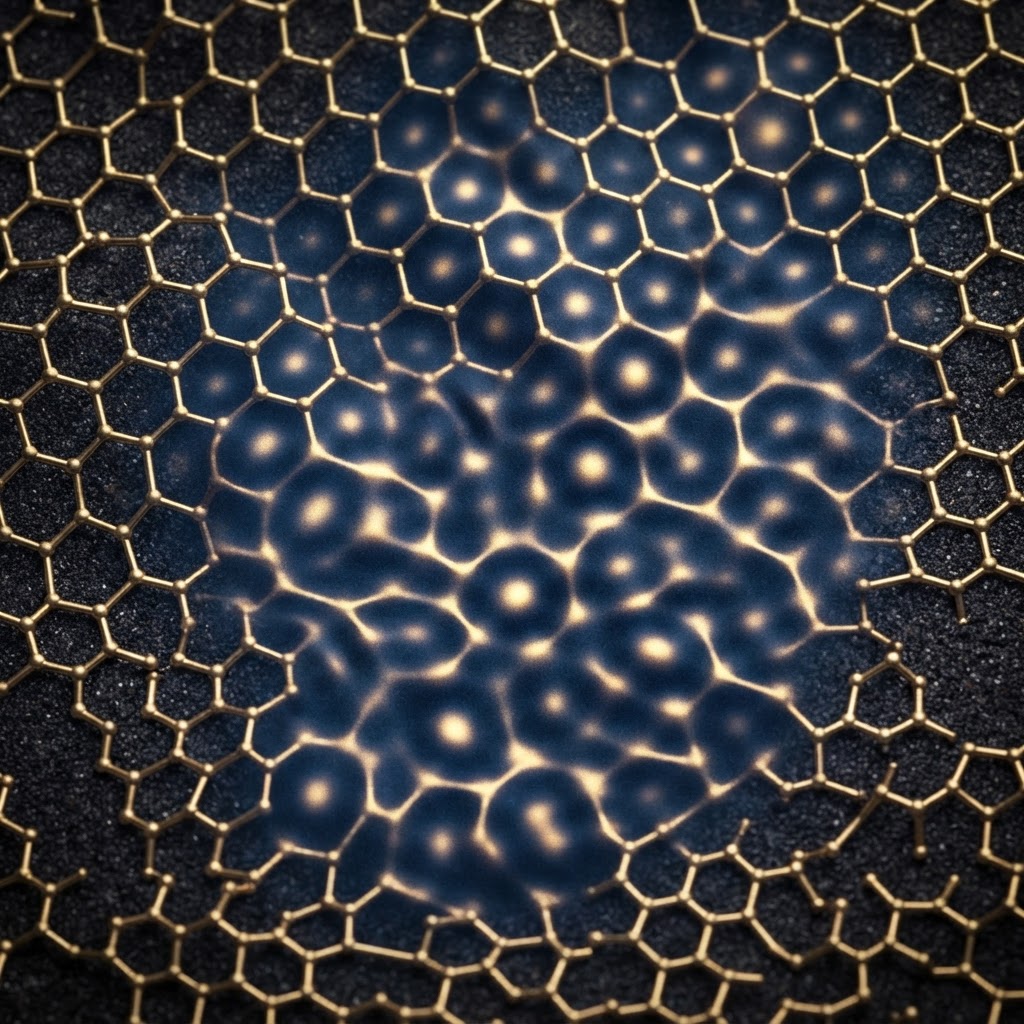
Lattice relaxation and reconstruction. When two atomically thin crystals are stacked with a twist, the atoms do not remain rigid. The moiré potential triggers in-plane and out-of-plane relaxations that change the local registry, redistributing the electronic weight of so-called "flat" bands. The idealized continuum model (Bistritzer–MacDonald) assumes rigid layers; relaxation breaks that assumption and shifts where — and how flat — the bands actually are.
Strain and twist disorder. Small, spatially varying strains change the local moiré period and thus the local effective angle. A nominally magic-angle sample may in practice be a patchwork of regions above and below the magic condition, producing percolation physics, filamentary superconductivity, and sample-to-sample variability.
Dielectric environment and screening. Coulomb interactions are central to the correlated phases, but they are also tunable. Gate electrodes, encapsulating dielectrics, and nearby metallic layers change the effective interaction range and strength, sometimes as much as adding or removing carriers. Misinterpreting intrinsic correlation physics without accounting for environmental screening is a common trap.
Band topology and symmetry-breaking. Flatness is necessary but not sufficient. The topology of moiré bands — fragile topological indices, valley Chern numbers, and the presence or absence of protecting symmetries — steers which correlated orders are favored. Small sublattice-symmetry-breaking perturbations or interlayer tunneling anisotropies can promote magnetism over superconductivity or vice versa.
Why the mess matters
The consequence is both sobering and exciting. Sobering because the early narrative of a single, universal mechanism for superconductivity in twisted bilayer graphene is incomplete: experimental phenomenology varies with device fabrication details that modulate these hidden knobs. Exciting because the expanded parameter space is precisely what gives twistronics its power. Instead of one magic recipe, researchers now have a palette of experimentally accessible controls to engineer phases—by design—such as changing the twist, applying strain gradients, tuning gate screening, or stacking dissimilar materials to add spin–orbit coupling and band asymmetry.
Where to look next
To make progress we need measurements that resolve local variability (STM, nanoARPES, scanning single-electron transistors) coupled with systematic device engineering: controlled strain fields, dual-gate screening platforms, and heterostructures that intentionally break or restore specific symmetries. Theorists must fold relaxation, lattice-scale effects and long-range Coulomb screening into realistic many-body calculations rather than treating them as perturbations.
A pragmatic view
Twistronics is not a single discovery that solves correlated electron physics; it is a practical toolkit for assembling complex, tunable quantum matter. The "messiness" that frustrated early attempts to extract universal answers is, properly harnessed, a design space. Recognizing and measuring the hidden parameters—the structural, dielectric and topological degrees of freedom—turns unpredictability into opportunity.
Final note: if you’re looking for the magic in moiré materials, don’t fixate on 1.1° alone. Follow the strain, watch the gates, and map the topology — the true magic is in controlling the mess.