Why this corner is overlooked
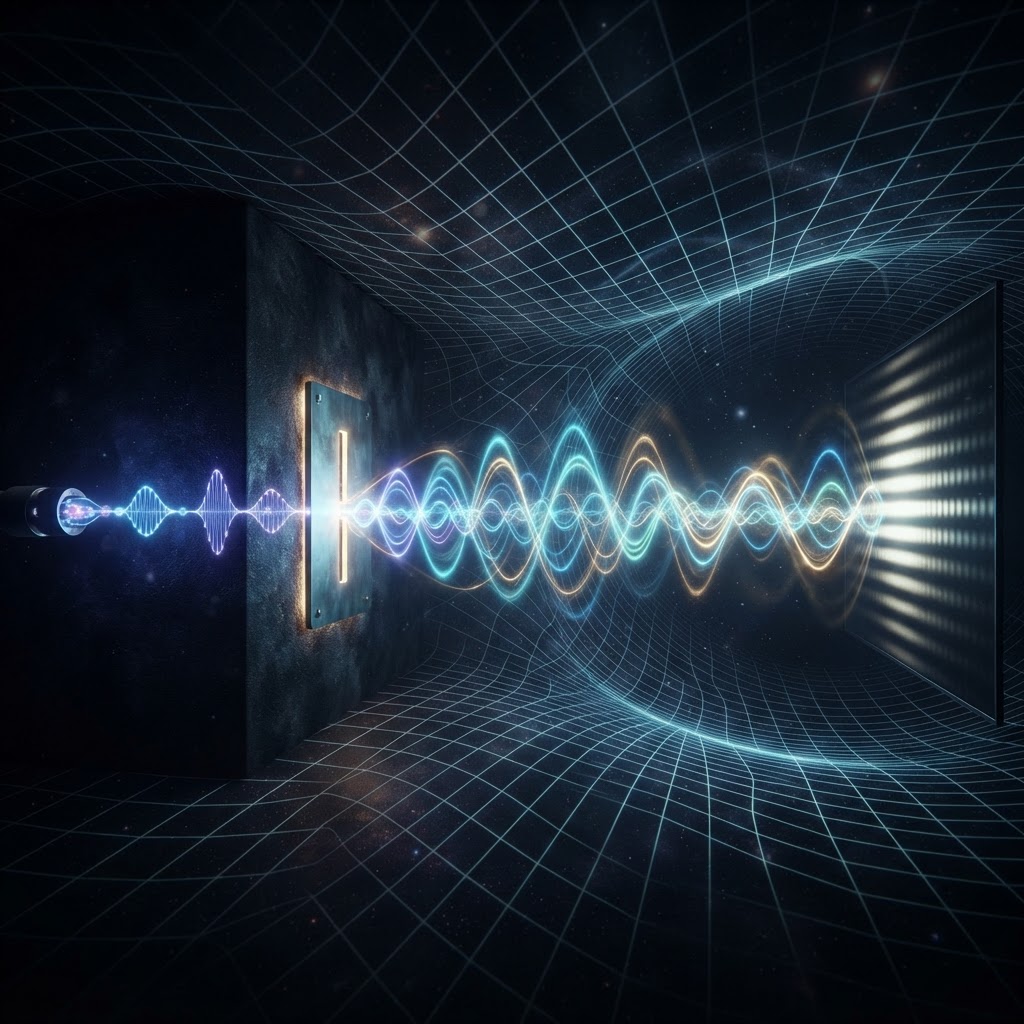
Most physicists accept that decoherence — entanglement with untracked degrees of freedom — explains why interference dies out for large systems. What is less appreciated is that gravity, by its universal coupling to mass and energy, provides both a ubiquitous decohering environment and a conceptual pressure point for the measurement problem. The literature splinters into proposals, calculations and heated debate; the upshot is subtle, important, and often misreported: gravity can suppress superpositions without producing definite outcomes.
Three distinct ideas compressed into one phrase
Gravitational decoherence is an umbrella term covering different mechanisms.
- Diósi–Penrose ideas: Penrose argued that superpositions of distinct mass distributions create ill-defined spacetime geometries and should be unstable, with a characteristic decay time set by the self-energy of the mass difference; Diósi proposed a stochastic master equation that mimics such a decay. These are often framed as gravity-induced collapse models.
- Semiclassical noise and stochastic gravity: If the gravitational field is treated as classical but sourced by quantum matter, the back-action introduces effective noise that decoheres matter. The prediction depends on how you model the coupling and regularize mass density operators.
- Relativistic time-dilation decoherence: Recent work shows that internal degrees of freedom acting as clocks accrue path-dependent phases due to time dilation; tracing out those clocks generates decoherence of spatial superpositions even in weak gravity.
Decoherence vs. collapse — the crucial distinction
Decoherence explains loss of coherence; it does not pick an outcome. A density matrix diagonalized in some pointer basis looks classical but, strictly speaking, still represents an ensemble of possibilities. Gravity-based decoherence models can render macroscopic superpositions effectively unobservable, recovering classical statistics for interference experiments. They do not, by themselves, solve the Born-rule question: why a single result occurs in an individual run.
Where the physics bites
Even if you accept gravity as a decohering agent, several stickier problems remain:
- Model-dependence: Different gravitational-decoherence proposals predict different rates and scalings with mass, size and geometry.
- Nonlinearity and signalling: Some collapse-style implementations introduce nonlinearity that can — if not carefully controlled — allow superluminal signalling.
- Energy bookkeeping: Objective collapse mechanisms often imply small but cumulative energy non-conservation; the gravitational sector complicates how we account for that.
Experiments on the near horizon
Levitated nanoparticles, large-mass interferometers and precision clock networks are closing the gap between theory and data. Time-dilation decoherence can be tested by putting internal-state superpositions on spatially separated paths; Diósi–Penrose-type lifetimes can be bounded by interference visibility in massive-object interferometry. The required mass and coherence times are daunting but not absurd — the coming decade will be decisive.
Why this matters
Gravitational decoherence occupies a rare bridge between quantum foundations and empirical gravity. If gravity merely decoheres, then the measurement problem remains metaphysical and experimental tests will constrain mechanisms and parameters. If gravity induces objective collapse, we have a path to falsifiable deviations from quantum mechanics — and a screamingly obvious target for table-top experiments.
Takeaway: Gravity may be a powerful agent of decoherence that pushes the quantum-to-classical transition toward the familiar world, but it does not automatically answer why individual outcomes occur — and resolving that requires both cleaner theory and daring experiments.