Why the question mattered
By the mid-1800s, physicians and public health officials debated whether disease arose from miasma, imbalance, or living contagion. The stakes were practical: sanitation, hospital practice, and emerging efforts to prevent infection depended on knowing whether disease could be transmitted by invisible organisms. What followed was not a single breakthrough but a pair of complementary scientific strategies that established germ theory as a working framework.
Pasteur: overturning spontaneous generation and demonstrating causality
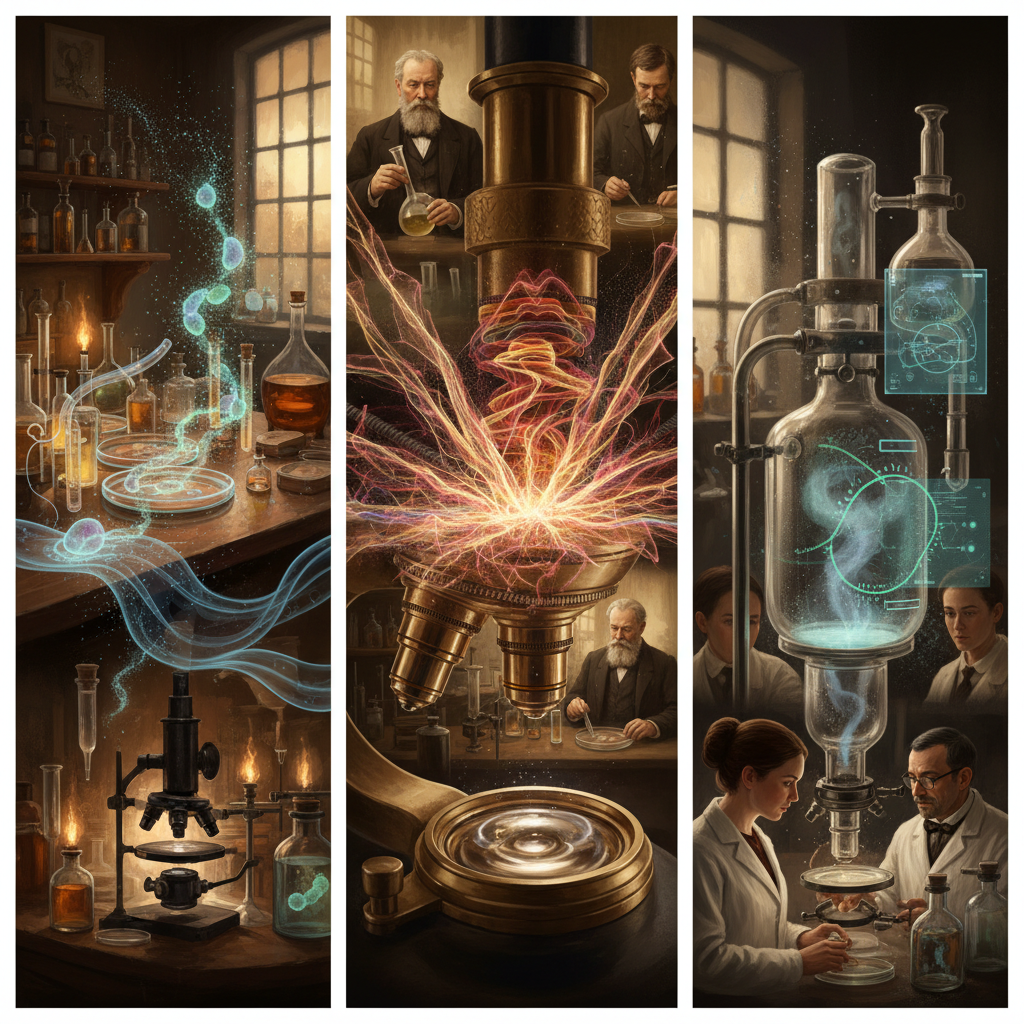
Louis Pasteur attacked the problem by making controlled observations and designing experiments that closed loopholes. In the 1850s and 1860s he showed that fermentation and putrefaction were driven by microbes, not by spontaneous generation. His famous swan‑neck flask experiments kept boiled broth free of contamination until airborne particles were allowed to reach it, demonstrating that microbes arrived from the environment rather than appearing de novo.
Pasteur went further: he connected microbes to disease prevention. He showed that attenuated microbes could induce immunity, pioneering vaccines for chicken cholera and later contributing to rabies prevention. His work converted the abstract idea that small organisms mattered into practical methods for control — sterilization, pasteurization, and inoculation.
Koch: isolating a killer and setting standards for causation
Robert Koch took a different tack: isolation and reproducibility. Working with anthrax and then tuberculosis, Koch developed a set of postulates that tied a specific microbe to a specific disease. His methods emphasized pure culture, reproduction of disease in healthy hosts, and re-isolation of the same organism. Microscopy, staining techniques, and solid media culture (the agar plate) were all part of the toolbox he introduced.
Koch’s approach provided a template for turning observation into proof: identify, isolate, reproduce, and re-isolate. Where Pasteur showed mechanisms and prevention, Koch provided a rigorous path for attributing disease to particular agents.
From 19th-century proofs to 21st-century nuance
Today these historical experiments remain foundational, but modern microbiology has revised how we apply them. Many pathogens cannot be cultured easily; some diseases are polymicrobial or depend on host factors. Sequence-based methods and molecular diagnostics address these limits. Scholars now use molecular Koch's postulates and genomic evidence to link genes and pathogens to disease processes rather than relying solely on classical culture-based criteria.
- Practical legacy: Sterilization, aseptic surgery, vaccines, and public sanitation all flow from the Pasteur–Koch synthesis.
- Methodological legacy: Controlled experiment and reproducibility define modern infectious disease science.
- Modern tools: Genomics, metagenomics, and advanced microscopy allow attribution when culture fails.
Why this still matters now
The Pasteur–Koch story is not only historic: it is immediately relevant. Antibiotic resistance, emerging pathogens, and the limitations of one-microbe–one-disease thinking mean we must combine classical rigor with modern molecular tools. When a novel outbreak appears, epidemiologists still draw on Koch’s emphasis on isolation and Pasteur’s emphasis on mechanism to detect, attribute, and interrupt transmission.
Open questions
Despite the clarity Pasteur and Koch brought, major challenges persist: how to define causation for complex, multifactorial conditions; how to attribute disease in the context of the microbiome; and how to translate genomic signals into public-health interventions. The century-and-a-half-old debate has matured into a program that blends old experiments with new technologies — and the work continues.