Hidden variation, visible disease
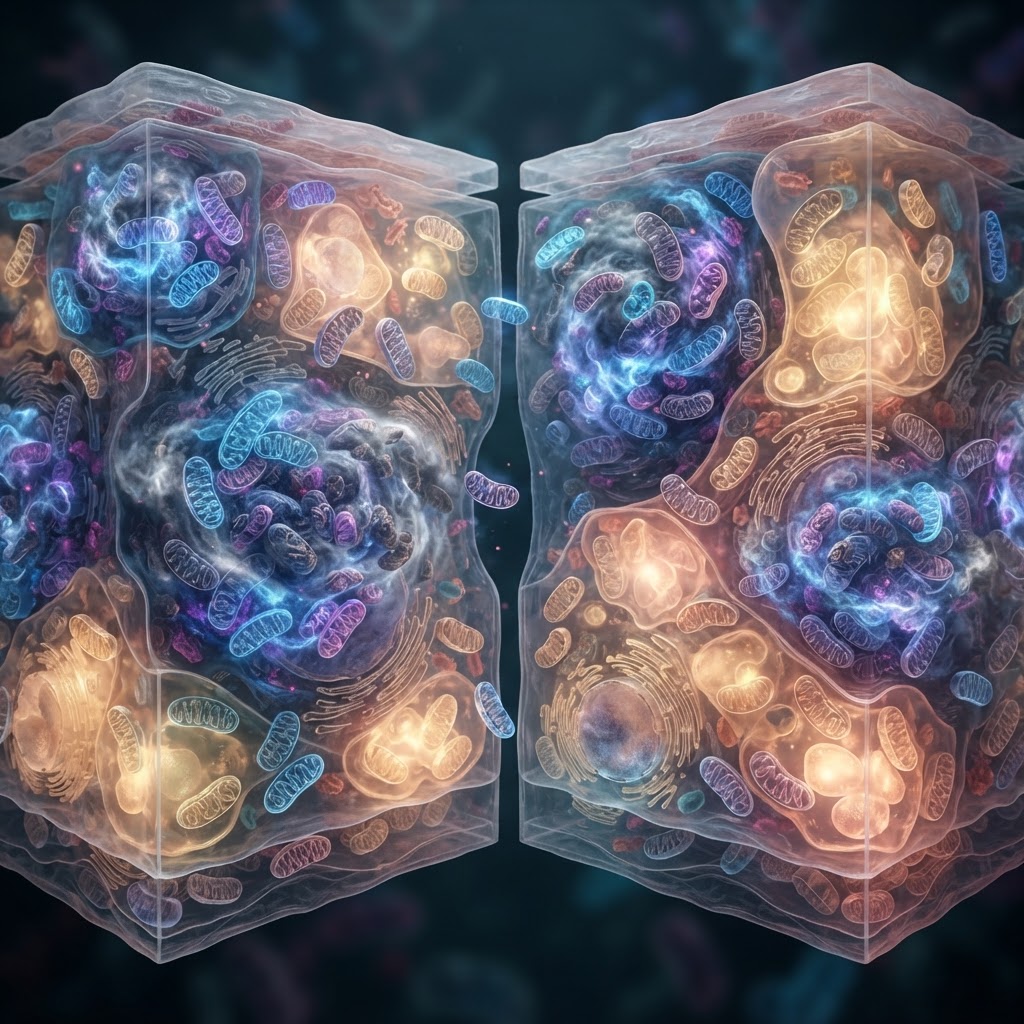
For patients and clinicians confronting mitochondrial disease, one stubborn puzzle keeps recurring: two people with the same pathogenic mitochondrial DNA (mtDNA) variant — sometimes even members of the same family — can have dramatically different symptoms. One develops myopathy, another diabetes, a third has almost no disease. The explanation increasingly points to heteroplasmy — the coexistence of mutant and wild-type mtDNA — and the way it distributes and drifts differently across tissues.
Why heteroplasmy is not a single number
It is tempting to quote a single heteroplasmy percentage (for example, 60% mutant) and call it a day. That number only describes the sample tested. What rarely makes headlines is that heteroplasmy is a spatially and temporally dynamic property. Two mechanisms matter most:
- Developmental bottleneck and mitotic segregation. During oogenesis and early embryogenesis, only a subset of mtDNA molecules is passed on to daughter cells. That bottleneck plus subsequent random segregation produces dramatic intercellular and intertissue differences in mutant load.
- Clonal expansion and selection. Over a lifetime, mutant mtDNA molecules can clonally expand within particular cell lineages, and selective forces — both positive and negative — act differently in different environments. For example, high-turnover tissues may selectively purge deleterious genomes from blood, but post-mitotic tissues like muscle or brain can accumulate dysfunctional clones.
Thresholds are tissue-specific
The classical “threshold” model — disease only appears when mutant load crosses a critical fraction — still holds, but the threshold is not universal. Energetically demanding tissues (retina, auditory system, cardiac muscle) can tolerate far less functional impairment. Cellular context also changes the effective threshold: cells with low mtDNA copy number or limited ability to upregulate biogenesis hit failure sooner. In practice this means a mutation that is subthreshold in peripheral blood can be well above threshold in skeletal muscle or the brain, producing organ-specific disease.
What clinicians and researchers often overlook
- Sampling bias: blood is convenient but a poor proxy for muscle, nerve, or brain heteroplasmy — especially for older patients where selection in blood can obscure inherited loads.
- Single-cell mosaicism: tissues are mosaics; pathogenicity may reflect a minority of cells that cross threshold and produce a local functional deficit.
- Nuclear background and environment: the same mtDNA variant interacts with nuclear-encoded mitochondrial genes, metabolic state, and exposures (eg, drugs, infection), reshaping penetrance.
Practical consequences
Diagnosis, counseling, and prognosis require context-sensitive measurement. High-sensitivity assays (droplet digital PCR, deep sequencing) and tissue-appropriate sampling (muscle biopsy, buccal cells, urine epithelial cells) often change clinical interpretation. For reproductive counseling, the reproductive bottleneck creates real unpredictability in offspring heteroplasmy; for longitudinal care, somatic drift and selection mean heteroplasmy measured once may not predict future tissue-specific decline.
Where this hidden corner points us
Two directions are urgent. First, routine use of tissue-appropriate, high-resolution heteroplasmy assays and, increasingly, single-cell approaches to map mosaicism. Second, research that integrates mtDNA dynamics with nuclear modifiers and cellular energetics to predict tissue trajectories — not just population averages. Until we can convert a heteroplasmy snapshot into a tissue-by-tissue forecast, mitochondrial medicine will remain a practice of informed probabilities rather than precise predictions.
Key takeaways
- Heteroplasmy is spatially and temporally dynamic; a single percentage from blood is often misleading.
- Tissue-specific thresholds, clonal expansion, and selection determine penetrance.
- Better diagnostics and integrative models are the overlooked levers that will improve prediction and treatment.
In short: mitochondrial genetics behaves less like Mendel and more like weather — local, fluctuating, and shaped by many interacting forces. Treat it as a dynamic mosaic if you want to see the disease it hides.