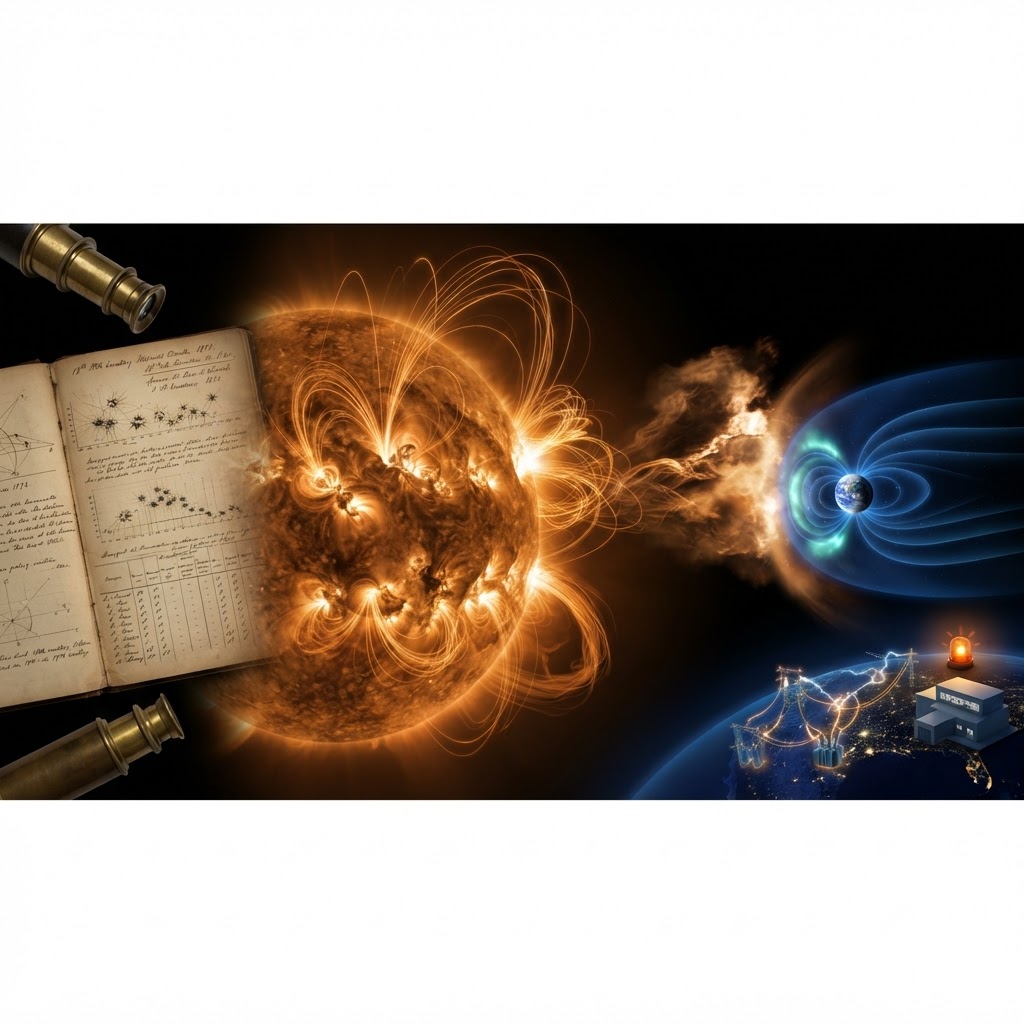
Executive hypothesis
Solar energetic particle (SEP) events are governed by a multi-scale acceleration pathway: localized magnetic reconnection in the low corona injects a suprathermal seed population into the nascent CME/shock environment; subsequent acceleration at the CME-driven shock is modulated by concurrent compressive and Alfvénic turbulence so that the final energy spectra, anisotropies, and heavy-ion composition reflect the combined action of injection physics, diffusive shock acceleration (DSA), and stochastic reacceleration.
Why this is plausible
Observations show that SEP events span a wide range of spectral shapes, timing relationships with flare/CME signatures, and compositional anomalies (particularly heavy-ion enhancements and variable charge states). No single mechanism—pure flare reconnection or pure DSA at shocks—consistently reproduces that diversity. In-situ and remote measurements (e.g., suprathermal tails measured by ACE/STEREO, early radio signatures of reconnection, and shock geometry diagnostics by Solar Orbiter and PSP) indicate: (1) the presence of pre-existing suprathermal seeds, (2) evolving shock obliquity and turbulence, and (3) evidence for magnetic islands and reconnection outflows near CME cores. The proposed hypothesis unifies these lines by giving explicit roles to seed injection and turbulence-modulated shock acceleration, both grounded in well-established plasma processes.
Mechanistic sketch
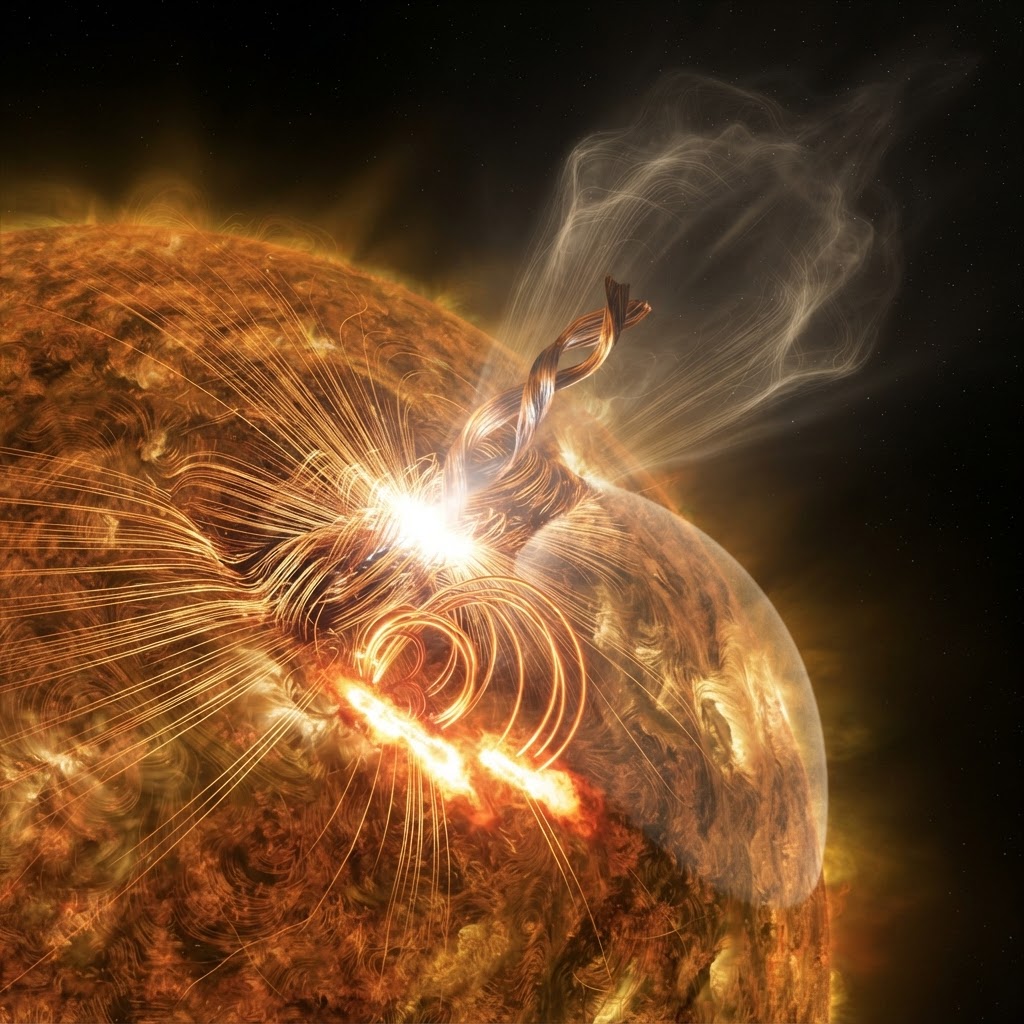
- Seed production: Small-scale reconnection in current sheets (flare loops, CME current sheets) forms magnetic islands and plasmoids. Contracting islands and parallel electric fields accelerate particles to suprathermal energies (tens to hundreds of keV), producing a nonthermal seed tail with composition biased by local plasma conditions.
- Injection into the shock: As the CME expands, its driven shock encounters the seed reservoir. Injection efficiency into DSA depends sensitively on the particle's rigidity, local shock-normal angle (θBn), and pre-existing turbulence level; suprathermals are preferentially injected, enhancing acceleration efficiency and modifying spectra.
- Shock and turbulence coupling: The shock generates and amplifies upstream and downstream turbulence (compressive modes, Alfvénic fluctuations). Stochastic acceleration (second-order Fermi) in the turbulent foreshock and downstream media reprocesses particle distributions, producing spectral curvature and energy-dependent anisotropies.
- Composition effects: Charge-to-mass (Q/A) dependent injection and wave–particle interactions produce the observed heavy-ion enhancements and energy-dependent charge-state signatures. Microinstabilities driven by streaming ions further tailor turbulence and scattering rates, creating feedback between particle populations and the accelerating medium.
Falsifiable predictions
- Early suprathermal flux (pre-shock) amplitude and spectral slope will correlate with peak SEP fluence and the spectral hardness of the subsequent event across a statistical sample. Null correlation falsifies dominant seed-role hypothesis.
- Spectral break energies (or rollovers) scale with measured upstream turbulence amplitude and correlation length at the shock crossing: higher turbulence shifts breaks to higher energies due to more efficient reacceleration.
- Events with persistent quasi-parallel shock geometry and strong upstream turbulence will show reduced anisotropy and softer spectra compared with quasi-perpendicular shocks that intercept strong seed tails (which yield harder spectra and stronger early anisotropy). Repeated contradiction of these patterns would refute the geometry–seed coupling claim.
- Charge‑to‑mass scaling of heavy-ion enhancements (e.g., Fe/O vs. Q/A) will follow a predictable power-law set by rigidity-dependent injection; systematic deviations across many events falsify the injection-dependence formulation.
Experimental roadmap
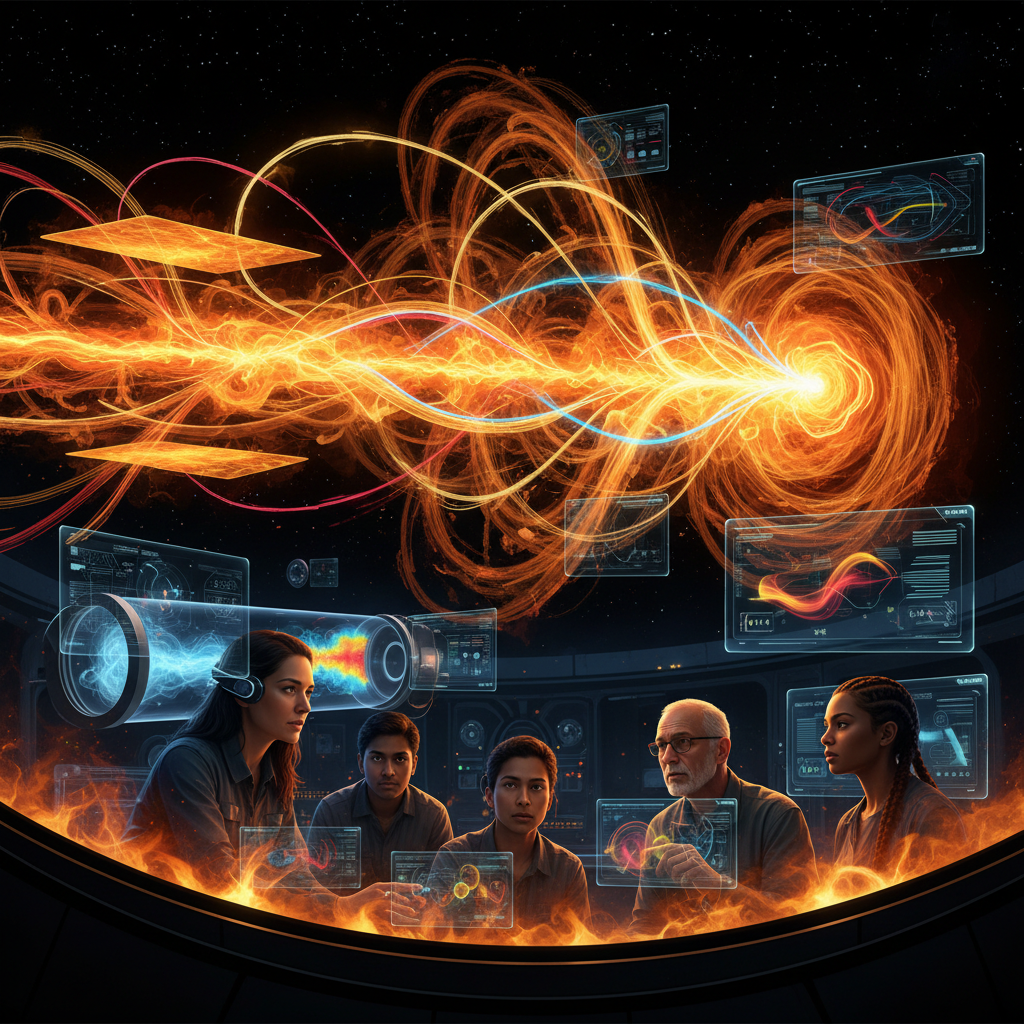
Combine coordinated multi-spacecraft observations with targeted numerical experiments.
- Observations: Leverage Parker Solar Probe (PSP) and Solar Orbiter to measure suprathermal tails, local turbulence spectra, and shock parameters near the Sun; use SDO/AIA and radio imaging (e.g., NRH, LOFAR) to identify reconnection islands and plasmoid ejections; use near‑1 AU assets (ACE, Wind, STEREO) to track SEP evolution. Prioritize events with temporally resolved remote signatures of reconnection preceding CME-driven shocks.
- Modeling: Run a hierarchy of simulations: kinetic PIC or hybrid simulations of reconnection to quantify seed spectra and composition; test-particle transport and DSA modeling in MHD shocks with measured turbulence spectra; coupled stochastic acceleration modules to model reacceleration. Produce synthetic spacecraft time series to compare with multi-point observations.
- Analysis: Perform event-by-event correlation studies across seed metrics, measured turbulence properties, shock geometry, and SEP observables (fluences, spectra, composition, anisotropy). Apply Bayesian model-selection to quantify evidence for the multi-scale model versus single-mechanism alternatives.
Controls and pitfalls
Instrumental biases: composition and charge-state measurements are sensitive to detector thresholds and transport effects—control by cross-calibrating instruments and using multi-instrument comparisons. Sampling bias: single-point spacecraft cannot fully sample shock surface or 3D turbulence—control via multi-spacecraft geometry and synthetic particle tracing. Modeling limitations: PIC/hybrid runs are computationally expensive and scale-limited; mitigate by embedding small-scale kinetic results into larger-scale MHD frameworks. Confounding processes: cross-field transport or interplanetary scattering can smear predicted anisotropy/composition signatures; address by focusing on near‑Sun observations where transport path lengths are shorter and by including realistic transport in forward models.
Implications
If validated, this multi-scale hypothesis reframes SEP forecasting: accurate predictions require not only CME/shock parameters but also knowledge of pre-eruption reconnection activity and local turbulence spectra. The proposal bridges solar and heliospheric plasma physics, linking reconnection microphysics to space-weather-relevant particle populations. Practically, it points to prioritized measurements (near‑Sun suprathermal populations and turbulence diagnostics) to improve short‑term SEP warnings and to fundamental advances in understanding particle injection, wave–particle coupling, and self-consistent feedback in astrophysical shocks.