The Anatomy of a Planetary Heartbeat
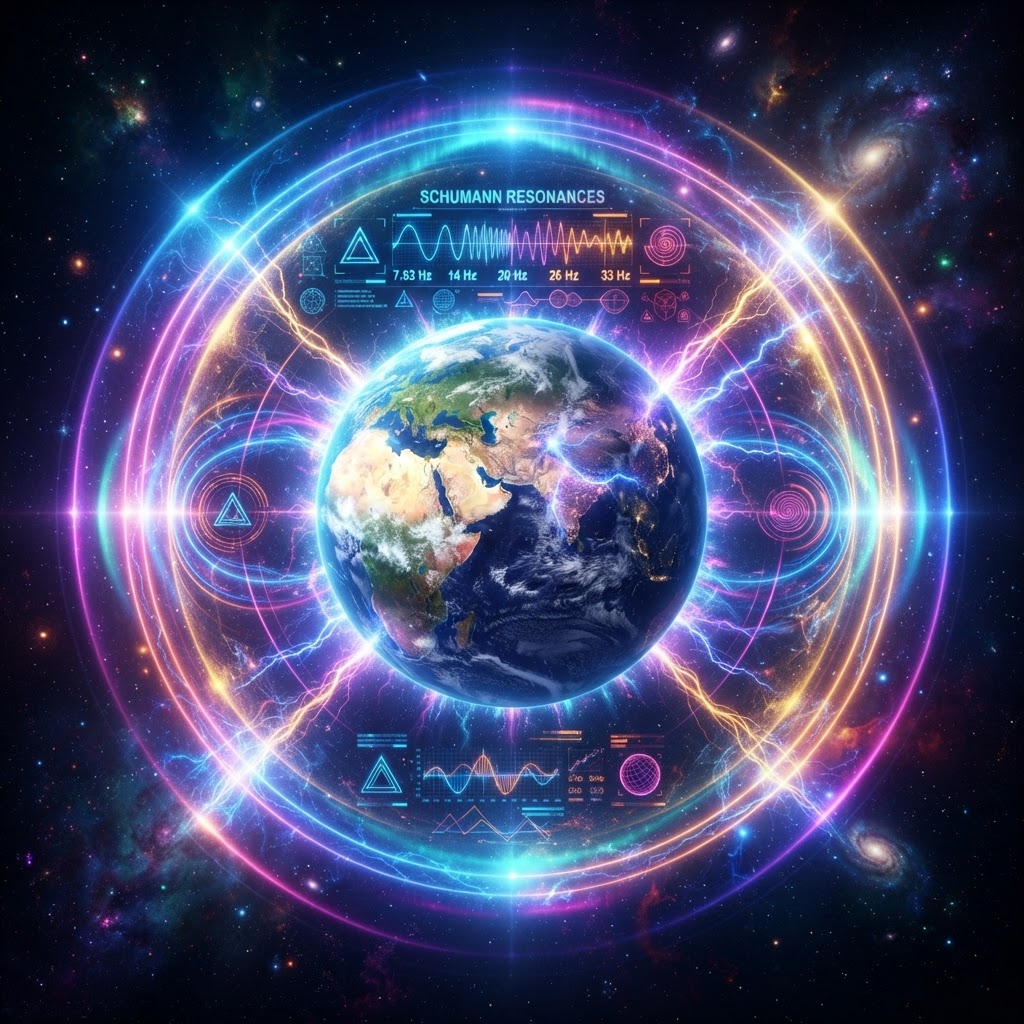
Between the Earth's surface and the lower ionosphere lies a colossal, spherical resonator. Within this cavity, electromagnetic waves generated by global lightning discharges propagate, creating a standing wave phenomenon known as the Schumann resonance (SR). First predicted by Winfried Otto Schumann in 1952, these resonances possess a fundamental frequency of approximately 7.83 Hz, with harmonics extending upward. For decades, geophysicists have utilized these extremely low-frequency (ELF) waves as a diagnostic tool for monitoring global thunderstorm activity and ionospheric conditions. However, recent anomalies in SR data have catalyzed a paradigm shift, moving the phenomenon from the exclusive domain of atmospheric physics into the frontier of biophysics.
Decoding the Recent Amplitude Spikes
In recent observation periods, monitoring stations have recorded massive spikes in Schumann resonance amplitudes, with the primary A1 mode occasionally peaking well above historical baselines. While popular culture often misinterprets these events as a shift in the fundamental frequency itself, rigorous atmospheric science points to complex global dynamics. According to recent research on Schumann Resonance Frequency Changes and Global Lightning Dynamics, these amplitude surges are heavily influenced by the day-night ionosphere asymmetry and the migration of active thunderstorm regions relative to observer nodes. Furthermore, extreme geological events play a role. As detailed in Recent Advances and Challenges in Schumann Resonance Observations, phenomena like the Tonga volcanic eruption generated acoustic-gravity waves that altered ionospheric conductivity, subsequently modulating the SR signal. These spikes are not mystical awakenings; they are profound indicators of a highly dynamic, coupled Earth-ionosphere system.
Bioelectric Resonance: Are We Wired to the Earth?
The most intellectually bold question surrounding SR is whether biological organisms, evolving within this ubiquitous electromagnetic cavity for billions of years, have developed a sensitivity to its rhythms. The fundamental frequency of 7.83 Hz overlaps precisely with the human brain's alpha rhythms, which are associated with relaxed, waking states. Early studies, such as those exploring Schumann Resonance Frequencies Found within Quantitative Electroencephalographic Activity, suggested an active coupling between neural dynamics and environmental oscillators. Modern biophysics is now investigating the cellular mechanisms behind this potential coupling. Evidence suggests that ELF fields, including SR, may modulate cellular calcium influx and efflux. This modulation likely occurs via indirect mechanisms involving field-sensitive molecules or radical pairs that affect ion channel behavior, thereby influencing critical cell signaling pathways, as explored in recent reviews on bioelectricity and human health.
Competing Hypotheses: Magnetite, Melatonin, and the Pineal Gland
How exactly does a weak, planetary-scale electromagnetic field interact with the micro-scale of human biology? Several competing hypotheses are currently under rigorous investigation. One prominent theory focuses on the pineal gland, a highly magneto-sensitive organ responsible for melatonin production and circadian rhythm regulation. Disruptions or spikes in the Earth's ELF environment might influence melatonin secretion, potentially explaining anecdotal reports of sleep disturbances during high-amplitude SR events. Another compelling hypothesis involves biogenic magnetite. As discussed in a 2025 comprehensive review on Schumann Resonances and the Human Body, the direct effect of SR amplitude variations could be mediated through the reaction of ferrimagnetic mineral nanocrystals embedded within human cells. These nanocrystals could act as microscopic transducers, converting subtle electromagnetic shifts into mechanical or chemical signals within the cellular matrix.
Open Questions and the Future of Bio-Electromagnetics
Despite tantalizing evidence, the field of bio-electromagnetics remains fraught with challenges. The primary unresolved issue is the signal-to-noise ratio: how do biological systems detect the incredibly weak Schumann resonances amidst the overwhelming electromagnetic noise of the modern, industrialized world? Furthermore, distinguishing genuine biophysical coupling from the placebo effect or unrelated physiological variations requires highly controlled, multi-disciplinary studies. Future research must focus on isolating the specific molecular pathways—such as the radical pair mechanism in cryptochrome proteins or the precise dynamics of voltage-gated calcium channels—under simulated SR conditions. As we continue to monitor the Earth's electromagnetic heartbeat, we are not just observing atmospheric weather; we may be decoding the fundamental environmental metronome that has quietly orchestrated the rhythm of life since its inception.