Introduction: a paradigm shift in plain sight
For most of modern medicine's history, the brain and the gut lived in separate chapters of physiology. The brain was the seat of thought and feeling; the abdomen, the digestive factory. That neat division began to dissolve as clinicians and scientists noticed that a gut disturbance could alter mood and that stress could upset digestion. The long arc that connected those observations to a mechanistic account of mood regulation runs through a single structure: the vagus nerve.
Roots: figures who reframed the internal milieu
The story begins with 19th- and early 20th-century thinkers who insisted that the body is an integrated system. Claude Bernard's 19th-century notion of the milieu intérieur and Walter Cannon's later work on homeostasis set the philosophical stage. Ivan Pavlov's demonstrations of conditioned digestive reflexes made the gut's responsiveness to the nervous system experimentally respectable. Then, in 1921, Otto Loewi performed his elegant experiment that proved chemical neurotransmission: stimulating the vagus of one frog heart slowed a second heart through a transferable chemical (vagusstoff, later identified as acetylcholine). Loewi's experiment tied the vagus nerve to brain–body chemistry and won him a Nobel Prize.
The enteric nervous system and ‘the second brain’
In the later 20th century, Michael Gershon crystallized a striking observation: the gut houses a vast, semi-autonomous network of neurons capable of coordinating complex behaviors. He called it "the second brain" — the enteric nervous system — and argued that gut-derived signals were not mere reflexes but active communicators with the central nervous system.
Vagal afferents: anatomy, signaling, and mood
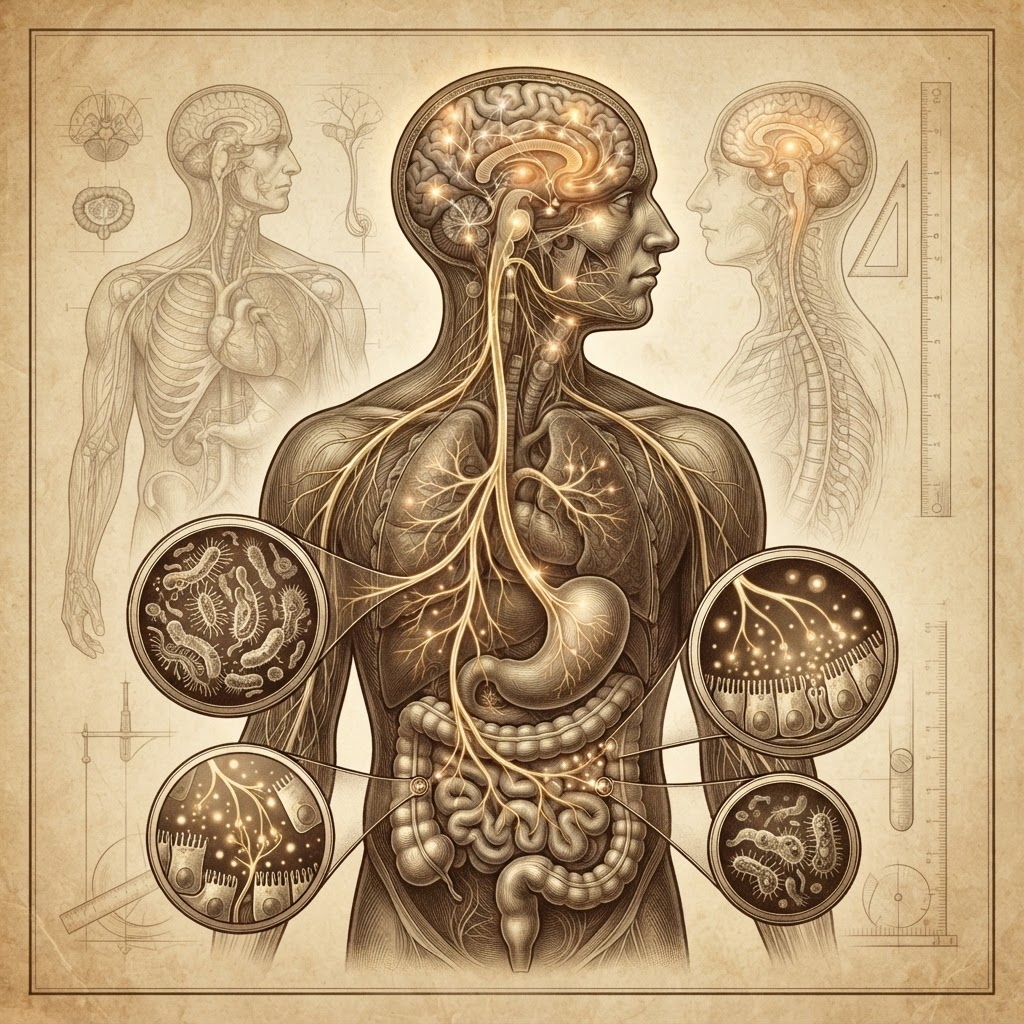
The vagus nerve is primarily an afferent pathway: roughly four-fifths of its fibers carry information from visceral organs to the brain. Those afferents terminate in the nucleus tractus solitarius (NTS) in the brainstem and relay to the hypothalamus, amygdala, hippocampus and other limbic structures. Through this route the gut influences stress circuits, reward pathways and neuroendocrine outputs.
Two major kinds of signals travel this road: neural (mechanical stretch, chemosensation) and chemical (microbial metabolites, gut hormones, cytokines). Microbes in the intestine produce short-chain fatty acids, neurotransmitter precursors and even molecules that alter vagal firing. The vagus translates that biochemical milieu into patterns of brain activity that shape mood, anxiety and social behavior.
Modern breakthroughs and people behind them
The last two decades turned speculative links into reproducible mechanisms. Kevin Tracey’s work on the "inflammatory reflex" showed how vagal efferents suppressed systemic inflammation; this connected vagal function to immune modulation — a key piece in understanding inflammation-associated depression. Jeffrey I. Gordon and other microbiome pioneers revealed how microbial communities shape host metabolism and immune tone, providing substrates that can modulate neural signaling.
Perhaps most influential for mood research are the psychobiotic studies led by John F. Cryan and Ted Dinan. Their experiments showed that specific bacteria alter anxiety-like and depressive-like behaviors in rodents — and, crucially, that many of these behavioral effects require an intact vagus nerve. A landmark rodent study (Bravo et al., 2011) demonstrated that ingestion of Lactobacillus rhamnosus altered GABA receptor expression in the brain and reduced anxious behavior in a vagus-dependent manner.
Clinical translation: stimulation, probiotics, and devices
Clinically, the vagus became a target. Implantable vagus nerve stimulation (VNS) devices, originally developed for epilepsy, were later approved for treatment-resistant depression, offering a new neuromodulatory option when pharmacology fails. More recently, noninvasive transcutaneous VNS and interest in "psychobiotics" — probiotic or dietary interventions designed to influence mood — have expanded the therapeutic landscape.
Why this matters now
The gut–brain axis reframes psychiatric illness as a systems problem: neurotransmitters matter, but so do microbes, immune signaling and visceral sensory traffic. That broader view explains why anti-inflammatory strategies, gut-targeted diets, vagal stimulation and microbiome alteration are plausible adjuncts in treating mood disorders. In a world with rising rates of anxiety and depression and variable response to existing treatments, these insights open parallel avenues for prevention and therapy.
Open questions and the path forward
Despite rapid progress, translation remains thorny. Rodent vagal anatomy and human vagal physiology are not identical; individual microbiomes vary widely; and the mechanisms by which particular metabolites influence specific mood circuits are still being mapped. The challenge for the next decade is to move from provocative correlations and animal models to precise, personalized interventions that reliably improve human mental health.
In short: the vagus nerve is not merely a cable between viscera and brain — it is a language translator, immune regulator and therapeutic gateway, and understanding its dialects may change how we treat the mind.