The attractive promise
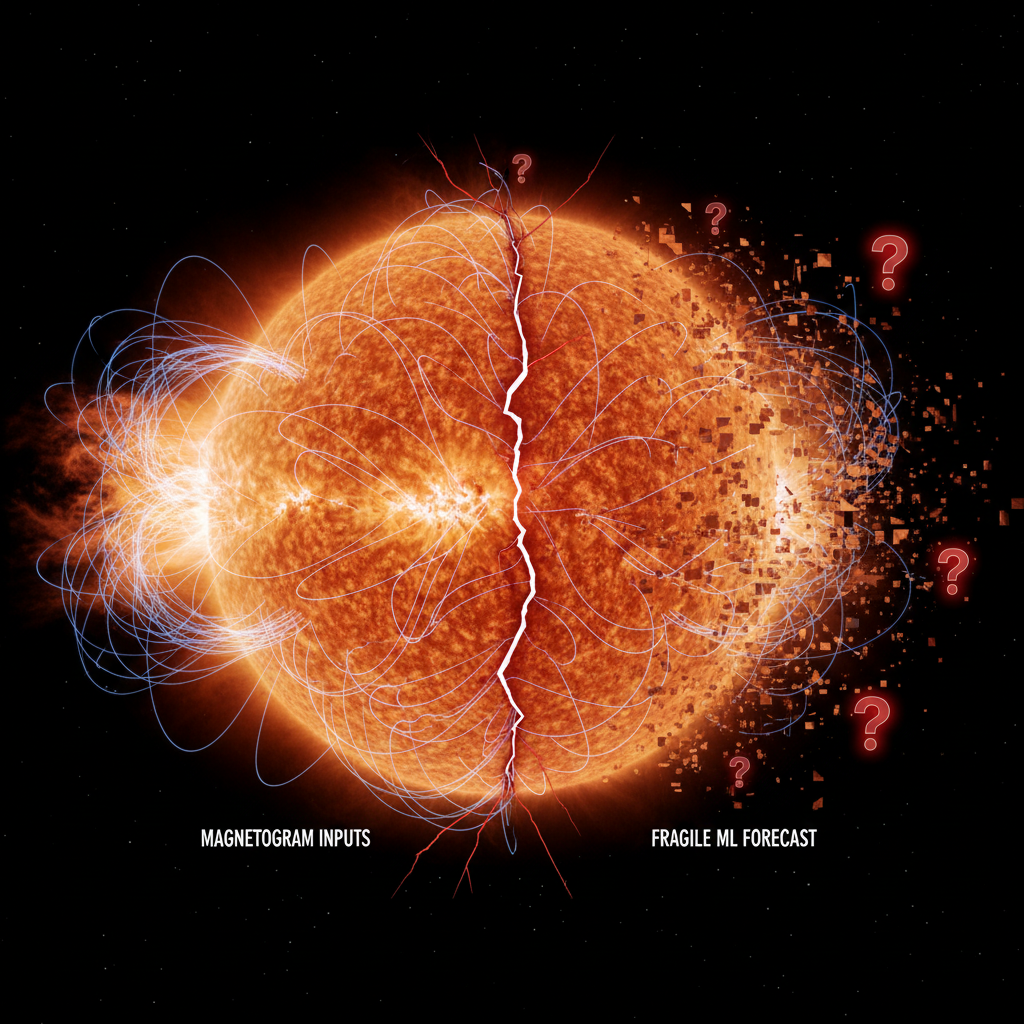
Magnetograms — maps of the photospheric magnetic field — are the obvious input for predicting solar flares. They are physically tied to the free magnetic energy and connectivity that drive reconnection. Over the past decade, machine learning teams have produced models that claim remarkably high skill: convolutional networks, random forests, and recurrent architectures trained on SDO/HMI patches and NOAA flare labels.
The overlooked fragility
What most papers and press releases gloss over is how easily those models learn dataset artifacts rather than the Sun’s causal physics. Put bluntly: a model can look smart by memorizing the training set’s statistical quirks — cadence, observation geometry, active-region identity, or labeling practice — and still fail when asked to forecast real, operationally useful onset times on unseen active regions or during a new solar cycle.
Common failure modes include:
- Data leakage: using temporally adjacent magnetograms from the same active region in both training and test sets inflates performance because the model effectively sees future states of the same system.
- Proxy learning: models latch onto proxies like NOAA region number, disk position (projection effects correlate with detection), or AR age rather than underlying instability indicators.
- Cadence and labeling artefacts: flare catalogs have coarse onset times and operational selection biases; ML models exploit timing windows that don't translate to real lead-time forecasting.
- Class imbalance and metric gaming: accuracy and ROC AUC can be misleading when >99% of images are non-flaring; skill scores like TSS or reliability diagrams are more honest but underused.
Deeper physical gaps
Magnetograms are necessary but not sufficient. The photospheric field is a boundary condition — the coronal topology, current sheets, and small-scale current systems that precipitate reconnection are partly invisible. High-scoring ML models may therefore be learning a probabilistic mapping from photospheric “looks” to historical flare occurrence rather than identifying an imminent, causal trigger.
How to make flare-forecast ML more robust
Some straightforward but under-adopted practices would weed out many false hopes:
- Use strict cross-validation that partitions by active-region identity and by contiguous time blocks so the model never sees the same AR in training and test.
- Demand realistic lead-time experiments: train for 24, 48, 72+ hour windows and report calibrated probabilistic forecasts rather than binary classification at arbitrary windows.
- Combine magnetograms with physically motivated features — helicity flux, connectivity metrics (QSLs), and coronal field extrapolations — or at least test whether learned filters correlate with those quantities.
- Report skill with appropriate metrics (TSS, reliability, Brier score) and test across solar cycles and near-limb cases to reveal operational weaknesses.
Why this matters
Operational space-weather forecasting hinges on trust. Overconfident models that fail in the wild erode that trust and waste resources. Conversely, disciplined ML that respects dataset provenance, testing rigor, and physics constraints can genuinely push forecasting skill forward.
The unresolved corner
The real scientific prize is not a black-box that flags likely flare days but a model that can tell us what in the evolving magnetic topology makes the difference between buildup and sudden release. Until ML researchers and solar physicists converge on validation practices and hybrid physics–data representations, many published gains will remain an alluring mirage.