Two hemispheres, one life—sometimes
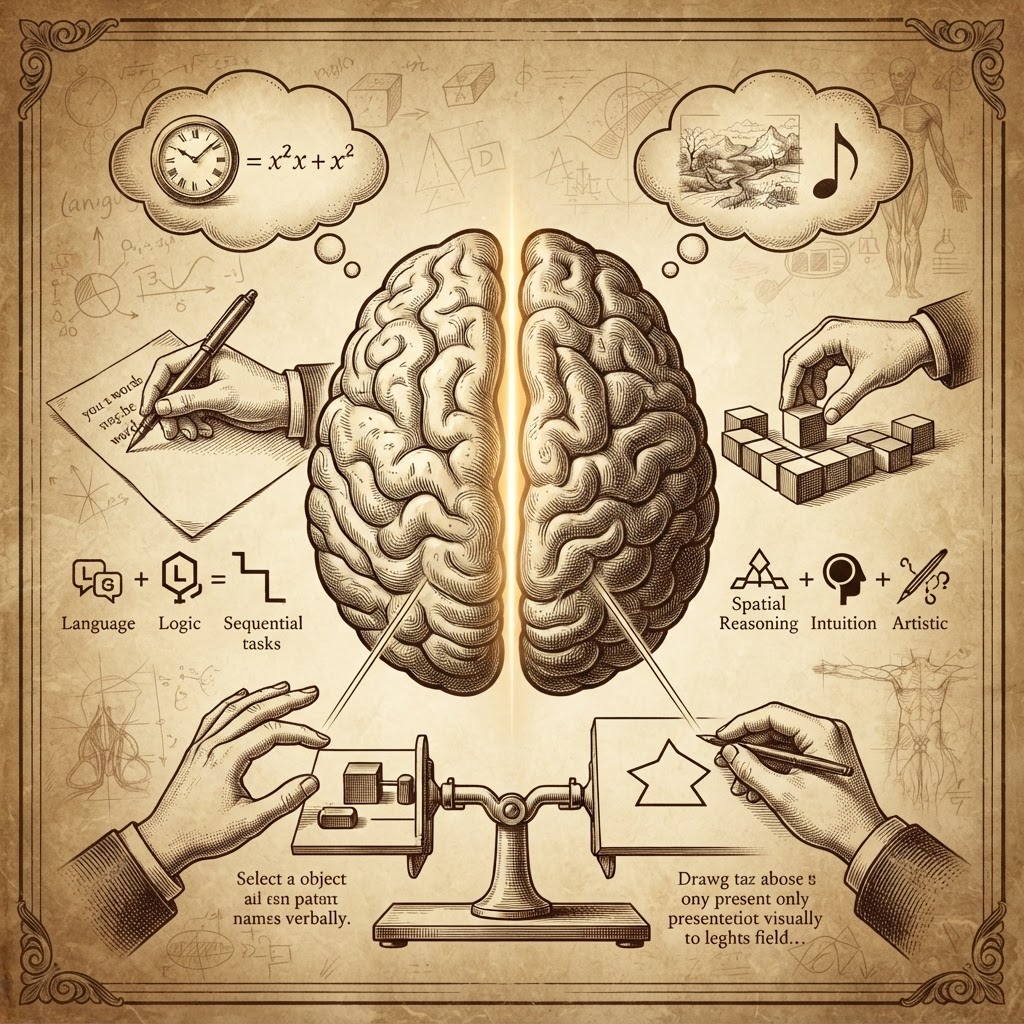
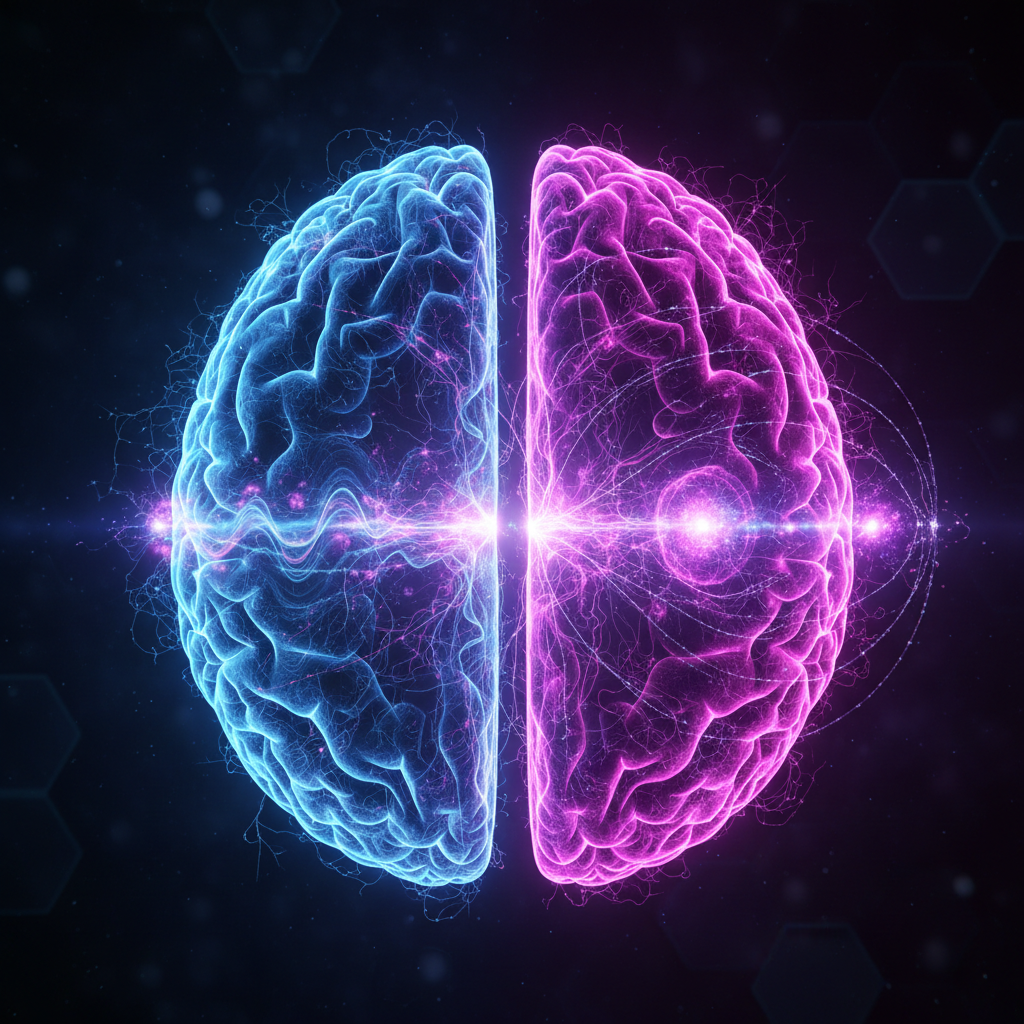
In the 1960s and ’70s neurosurgeons treating severe epilepsy began cutting the corpus callosum, the massive fiber bundle that links the two cerebral hemispheres. The operation—commissurotomy—produced patients whose hemispheres could no longer share information directly. The results were striking, often cinematic: a word flashed to a patient's left visual field (processed by the right hemisphere) could not be named, yet the left hand could reach into a box and select the matching object. The patient would then invent a plausible explanation, offered confidently out loud, for an action that the speaking hemisphere had not guided.
What the experiments actually showed
Functionally separable processors: basic perceptual and motor tasks, simple language comprehension, and emotional responses could be handled independently by each hemisphere. The right hemisphere could recognize faces, respond emotionally, and guide nonverbal actions; the left hemisphere retained most verbal reporting and the ability to narrate behavior.
The left-hemisphere "interpreter": Michael Gazzaniga and colleagues documented how the verbally dominant left hemisphere will generate a coherent story for actions it did not initiate—confabulation that reveals a constructive process. The sensation of a single, continuous self, it seems, can be a post hoc explanation produced to make sense of behavior.
Why this is still under-explained
The popular takeaway—"split brains = two minds"—is both too dramatic and not dramatic enough. It is misleading because it treats consciousness as an all-or-none property: either one unified subject or two separate persons. The evidence is finer. Commissurotomy reveals that:
- Conscious capacities can be dissociated: perceptual access, action control, and verbal report do not always align.
- The narrative unity of the self is a cognitive labor of interpretation, not a metaphysical given.
- But the existence of two completely independent conscious subjects in a single skull is not empirically established; most patients continue to behave coherently in everyday life.
Why did we miss these subtleties for so long? Partly because experiments relied on single-case demonstrations, partly because the dramatic anecdotes overshadowed careful inference, and partly because our language—"two minds"—is too blunt to capture graded, modular dissociations.
Limits, caveats, and the modern view
Commissurotomy patients are rare, and the brain reorganizes. Subcortical pathways and spared commissural fibers can maintain subtle cross-talk. Moreover, the measures we use—verbal report and simple behavioral tests—are coarse proxies for subjective experience. From a modern perspective, split-brain findings are best read as revealing the brain’s architecture: distributed processors with specialized roles, and a mechanism (the left-hemisphere interpreter among others) that stitches behavior into narrative continuity.
What this teaches us about consciousness
Two lessons stand out. First, unity of consciousness is not a primitive axiom of neurobiology; it is an outcome of integrated processing and interpretive operations. Second, verbal report is a constructed output, not an infallible guide to what is ‘‘going on’’ in every processing module. Those points recalibrate debates about free will, selfhood, and clinical practice—forcing us to separate claim from performance when we ask, "Who experienced this?"
Commissurotomy did not answer the hardest questions about subjective experience. But it pulled back a curtain: consciousness can be parceled, narrated into unity, and—critically—studied as an emergent property of information flow rather than as an indivisible soul.