For most of human history, disease had no visible enemy. Epidemics appeared as acts of providence, punishments, poisonous vapors, or mysterious imbalances within the body. Physicians could observe symptoms, chart outbreaks, and offer remedies, but they could not identify a living cause moving from host to host.
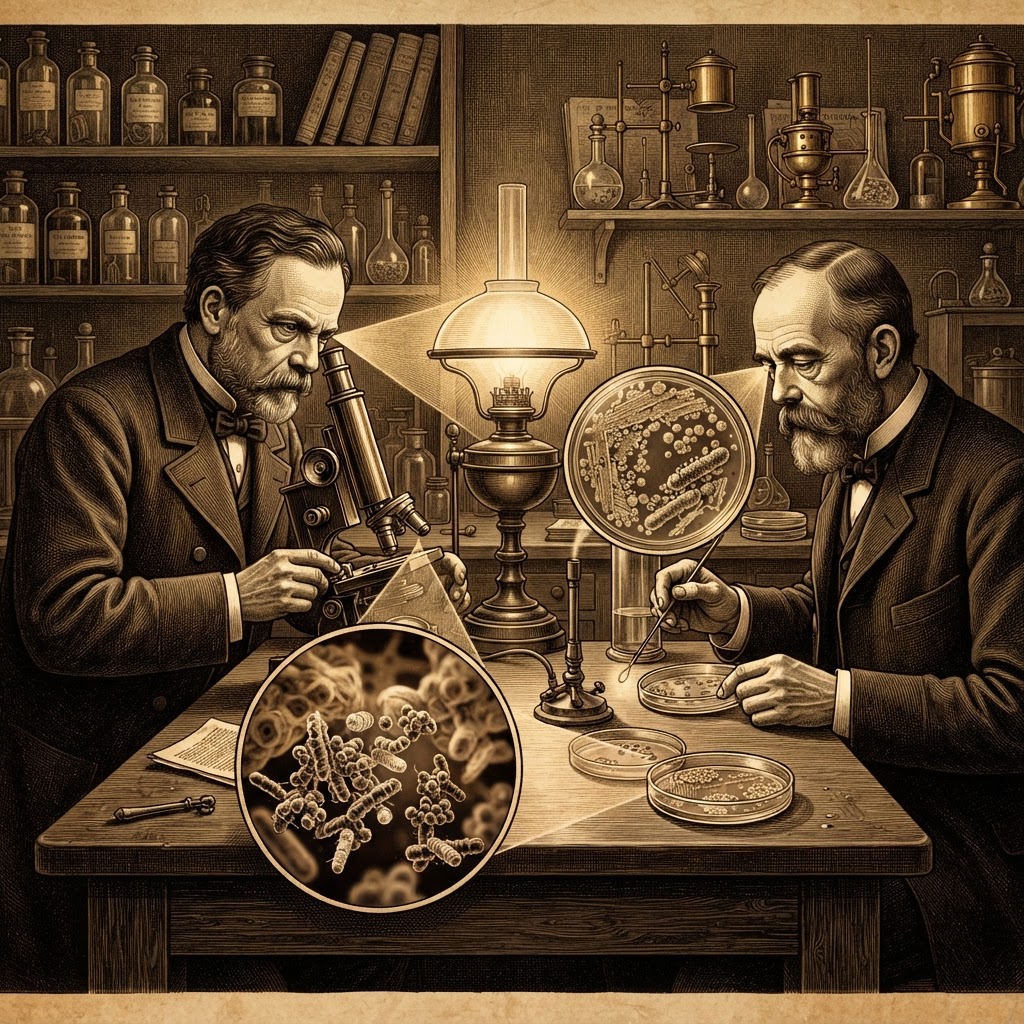
In the nineteenth century, that changed. Louis Pasteur and Robert Koch helped establish a radical proposition: microscopic organisms could cause specific chemical changes and specific diseases. Their work did more than add microbes to medical textbooks. It changed what counted as evidence, made prevention measurable, and opened the modern age of microbiology.
Before the germ
The dominant explanation of epidemics was often miasma: disease was thought to arise from foul air produced by sewage, decay, or overcrowding. The theory was not entirely foolish. Filth and stagnant water really did accompany illness. But miasma confused correlation with cause.
Other traditions invoked spontaneous generation—the idea that living organisms could arise directly from nonliving matter. Maggots seemed to emerge from meat; microbes appeared in nutrient broths. If life could simply materialize, invisible organisms were unlikely to be regarded as agents that traveled, multiplied, and invaded tissues.
Some physicians began to challenge this view. Ignaz Semmelweis showed that handwashing sharply reduced deaths from childbed fever in Vienna. John Snow traced a cholera outbreak in London to contaminated water. Yet the microbial explanation remained controversial. The decisive evidence would require experiments that connected invisible life to reproducible biological change.
Pasteur and the living chemistry of fermentation
Louis Pasteur, a French chemist, entered the debate through fermentation. In the 1850s, while studying wine and beer, he found that different fermentations were associated with different microscopic organisms. Yeast was not merely a passive chemical ingredient: it was a living agent that converted sugar into alcohol. Other microbes produced acids and spoiled industrial products.
Pasteur’s insight was profound because it linked a visible transformation to a specific population of living cells. Fermentation was not an inevitable rearrangement of matter. It was biology at work.
His swan-neck flask experiments made the argument especially vivid. Pasteur boiled nutrient broth in flasks whose long, curved necks allowed air to enter but trapped dust particles. The sterilized broth remained clear. When the neck was broken—or the flask was tilted so dust could reach the broth—microbial growth appeared. Air itself was not the source of life; organisms carried on particles in the environment were.
Pasteur extended these findings to disease. During outbreaks among silkworms, he identified microscopic agents associated with illness and advocated selecting healthy stock. He also developed vaccines against chicken cholera, anthrax, and rabies, demonstrating that laboratory manipulation of a microbe could produce protection against the disease it caused. His work helped replace spontaneous generation with biogenesis and transformed fermentation, hygiene, vaccination, and surgery.
Koch and the logic of causation
Pasteur showed that microbes could drive biological processes. Robert Koch, a German physician, supplied a more exact method for linking a particular microbe to a particular disease.
Working first on anthrax, Koch used microscopy, culture, and animal transmission to follow the disease-causing organism through its life cycle. He demonstrated that the bacterium Bacillus anthracis could be isolated, grown, and transferred to healthy animals, which then developed anthrax. He also clarified how its hardy spores allowed the organism to persist in soil.
Koch’s studies of tuberculosis and cholera made the implications impossible to ignore. In 1882 he announced the discovery of the tubercle bacillus, the cause of tuberculosis, then one of humanity’s great killers. The following year he identified the cholera vibrio and connected its spread to contaminated water.
His famous postulates expressed a disciplined framework: the organism should be found in diseased hosts, isolated and grown, reproduce the disease in a susceptible host, and then be recovered again. The rules were not universally applicable—some microbes cannot be cultured easily, and some infections have asymptomatic carriers—but they established a powerful standard for causal reasoning.
A revolution in the clinic
Germ theory changed medicine because it converted prevention from custom into mechanism. Sterilization could be understood as the removal of infectious agents. Antiseptic surgery could be tested. Clean water and sewage treatment became biological interventions, not merely matters of comfort. Vaccination acquired a laboratory foundation. Later came antibiotics, diagnostic cultures, molecular tests, and epidemiology built around chains of transmission.
The revolution was also intellectual. Disease was no longer only a disturbance of the whole body or a property of a polluted environment. It could have a specific agent, a route of entry, an incubation period, and a measurable cycle of replication.
Modern medicine has refined rather than simply repeated Pasteur and Koch. Viruses require living cells; microbiomes can protect as well as harm; chronic diseases may arise from many interacting causes; and a pathogen’s presence does not always guarantee illness. Yet the central achievement endures. Invisible life became experimentally knowable—and once it could be known, it could be interrupted.
Every sterile instrument, treated water supply, vaccine, culture plate, and infection-control protocol carries the imprint of that nineteenth-century transformation. Pasteur and Koch did not merely discover germs. They taught medicine how to prove what an unseen cause was doing.